
What Is a Magnetic Drill? 3 Specs That Decide Its Real Job
This post contains affiliate links. As an Amazon Associate, we earn from qualifying purchases.
A magnetic drill is a portable power tool that locks onto steel with an electromagnetic base, allowing you to drill large, precise holes in structural beams, plates, and pipes in any orientation, even overhead. It combines the stability of a drill press with the mobility needed for on-site fabrication, using specialized annular cutters that cut clean holes faster than standard twist drills.
The magnet’s hold isn’t a guess. It’s a physics equation written in manufacturer manuals: you need a minimum of 6mm (1/4 inch) of clean, ferrous steel under the base for full adhesion. Drop below that, or try to stick it to aluminum, and the tool becomes a 35-pound hazard. That’s the line between a productive tool and a dropped liability.
What follows is a breakdown of the three core components, the magnet-hold rules that aren’t optional, and the one cutter technology that makes the whole system work. By the end, you’ll know whether a mag drill fits your shop and, if it does, which specs actually matter.
Key Takeaways
- The electromagnetic base requires at least 6mm of clean, ferrous steel for a secure hold; thinner or non-ferrous materials demand a vacuum base or a clamped steel plate.
- Annular cutters, not twist drills, are the standard for mag drills, they remove a ring of material, not a solid core, which requires far less power and produces cleaner holes.
- Always use a safety chain or harness as a backup; a power loss or a sudden torque event can disengage the magnet instantly.
- Corded models offer consistent high torque for production work, while cordless magnetic drills like the Milwaukee M18 FMDP provide unmatched portability for remote sites.
- The rated drilling capacity (e.g., 32mm, 50mm) is the maximum diameter hole the tool can drill in steel; buying at your exact need leaves no room for occasional larger jobs.
How Does a Magnetic Drill Actually Work?
A magnetic drill replaces the massive cast-iron frame of a drill press with a powerful electromagnet. You place the base on a steel beam, flip a switch, and it locks on with thousands of newtons of force. The entire unit, motor, gearbox, and vertical slide, becomes a fixed drilling station. This lets you advance the cutter into the workpiece with a handle, just like a benchtop press, but you’re doing it on a vertical column 20 feet in the air or underneath a pipe.
The electromagnetic base of a magnetic drill generates a holding force typically rated between 9,000 and 25,000 Newtons on clean, flat steel that is at least 25mm thick. This force is created by an electric current passing through coils within the base, which ceases immediately if power is lost. The tool’s stability depends entirely on material thickness, surface cleanliness, and magnetic contact area.
The three-part design is simple but non-negotiable. First, the electromagnetic base is the anchor. Second, the vertical slide and feed handle give you controlled, precise downward pressure. Third, the drilling motor and arbor hold the cutting tool. The magic is in how these parts let you work in positions a traditional drill press never could.
The 3 Parts You Can’t Work Without
- Electromagnetic Base: This isn’t a permanent magnet. It requires power to create the magnetic field. The moment you cut power, the hold is gone. That’s why the safety harness rule exists.
- Vertical Slide & Feed Handle: This rack-and-pinion gear system is what gives you drill-press precision. You’re not pushing the tool by hand; you’re turning a handle that advances the cutter a predictable fraction of an inch per rotation.
- Drilling Motor & Arbor: The motor is geared for high torque at low RPMs, perfect for metal. The arbor is a specialized chuck, usually a Weldon-style shank, that accepts annular cutters. Some models include a chuck adapter for using standard drill bit types, but that’s a secondary function.
What Are the Real Limits of the Magnet?
The magnet’s strength is a rated number, but its real-world performance hinges on conditions no spec sheet can control. Think of the rated hold force, say, 8.89 kN for the Milwaukee M18 FMDP, as a best-case scenario on perfect, thick steel.
| Condition | Effect on Hold | Safe Workaround |
|---|---|---|
| Material < 6mm (1/4″) thick | Severe loss of adhesion; tool can slip or fall. | Clamp a thicker steel plate to the backside of the workpiece. |
| Non-ferrous metal (Aluminum, Stainless 304) | No magnetic hold at all. | Use a vacuum base accessory or securely clamp the drill to a steel plate fastened to the workpiece. |
| Dirty, painted, or curved surface | Dramatically reduced contact area, weak hold. | Grind the surface clean and flat; use a dedicated pipe adapter for curved surfaces. |
| Partial contact (base overhanging edge) | Dangerous leverage; tool can pivot and detach. | Ensure the entire base is on solid, supported material. |
Where this goes sideways: Assuming the magnet holds on thin sheet metal. I’ve seen a 30-pound drill shift on a painted 10-gauge sheet during the cut. The cutter bound, the drill torqued, and the whole unit slid six inches before the safety chain caught it. That was on a surface that looked perfectly fine.
The international safety standard for these tools, IEC 62841-3-15, exists precisely because of these failure modes. It sets the engineering benchmarks that prevent the magnet from letting go under normal drilling loads. But the standard can’t fix a dirty worksite or a too-thin beam. That’s on the operator.
For materials that simply won’t magnetize, like aluminum, some professionals use a related trick from the workshop: magnetizing drill bits can help hold screws, but it doesn’t solve the base adhesion problem. You need a mechanical clamp or a vacuum system.
Annular Cutter vs. Twist Drill: Why the Shape Changes Everything
If you try to drill a 1-inch hole through a 1-inch steel beam with a standard twist drill, you’re fighting a losing battle. You need enormous power, you’ll produce a mountain of stringy chips, and the hole will rarely be perfectly round. The annular cutter is the invention that made magnetic drills practical.
An annular cutter, like the Hougen Copperhead carbide-tipped series, looks like a hollow cylinder with cutting teeth on the end. It only shears away a ring of material, leaving a solid core slug in the center. This requires up to 80% less thrust force and horsepower than a twist drill removing the entire cylinder of material.
The Performance Difference
- Speed & Power: An annular cutter can drill a large-diameter hole several times faster with the same motor.
- Hole Quality: It produces a clean, burr-minimized hole with a tighter diameter tolerance.
- Chip Removal: The chips are short and fall easily out of the cutter’s flutes, preventing binding.
- Tool Life: The cutting load is distributed across multiple teeth, leading to longer life between sharpening.
This is why asking “what is a magnetic drill” is almost the same as asking “what is an annular cutter drill.” The two technologies are paired. While you can mount a chuck and use twist drills for small holes, the machine’s design is optimized for the annular cutter’s efficient, high-torque cutting action.
For the actual drilling to work, you need to secure the workpiece. In welding, magnetic welding clamps are invaluable for holding steel, but they’re for fabrication, not for securing your drill. The mag drill’s own magnet is its clamp.
Corded vs. Cordless Magnetic Drills
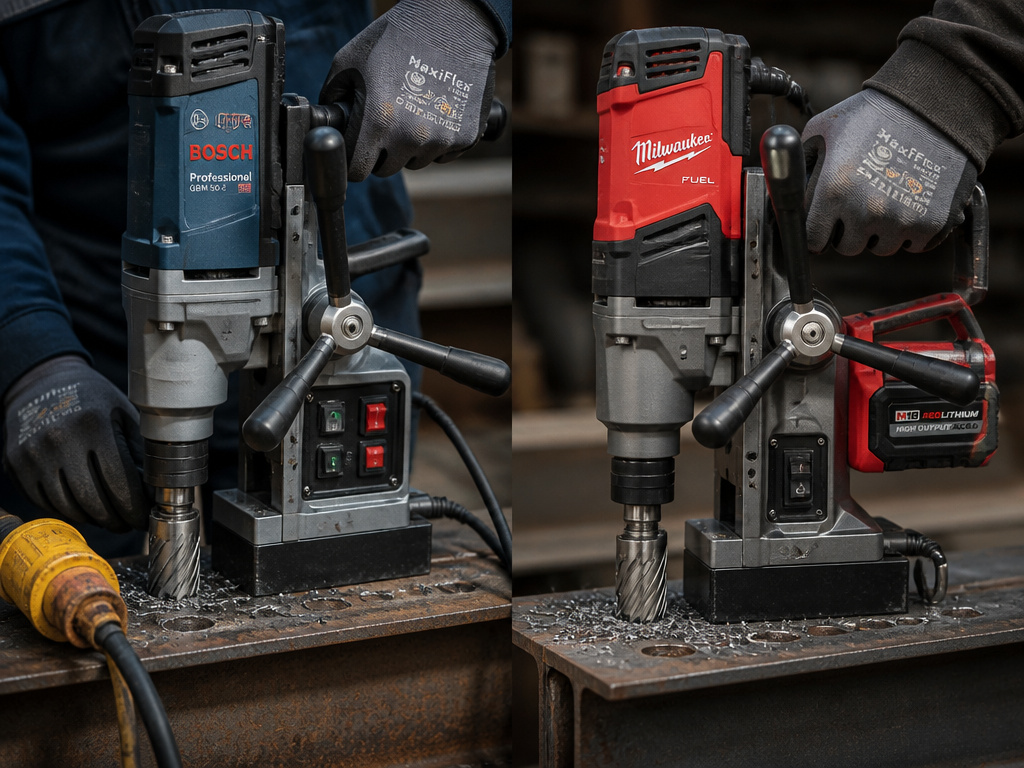
The choice here isn’t about convenience; it’s about the work environment and required power. Each type owns a specific niche.
| Feature | Corded Magnetic Drill (e.g., Bosch GBM 50-2) | Cordless Magnetic Drill (e.g., Milwaukee M18 FMDP) |
|---|---|---|
| Power Source | 110V/240V AC outlet | 18V Lithium-ion battery platform |
| Best For | Shop work, production fabrication, long runtime tasks | Remote sites, overhead work, locations without easy power |
| Typical Capacity | Higher (e.g., 50mm) | Lower to mid-range (e.g., 38mm) |
| Key Limitation | Tethered to a cord; requires stable grid power | Limited by battery life and peak torque |
The Bosch PRO GBM 50-2 represents the corded benchmark. Its 1200W motor and two-speed gearbox (50-250 RPM and 100-510 RPM) deliver consistent torque for all-day drilling of holes up to 50mm. You’ll find it in structural steel shops where the beam never moves.
The Milwaukee M18 FMDP is the flag-bearer for cordless freedom. Its 18V platform means you can haul it up a ladder or into a confined space without hunting for an extension cord. The trade-off is runtime and ultimate cutting diameter, it maxes out at 38mm with an annular cutter. It’s the tool for maintenance crews and on-site installers.
Skip this if: You only drill a few holes a month in a home garage. The investment and safety overhead are significant. A heavy-duty drill press or a good handheld drill with a guide is far more practical.
What Do You Actually Use a Magnetic Drill For?
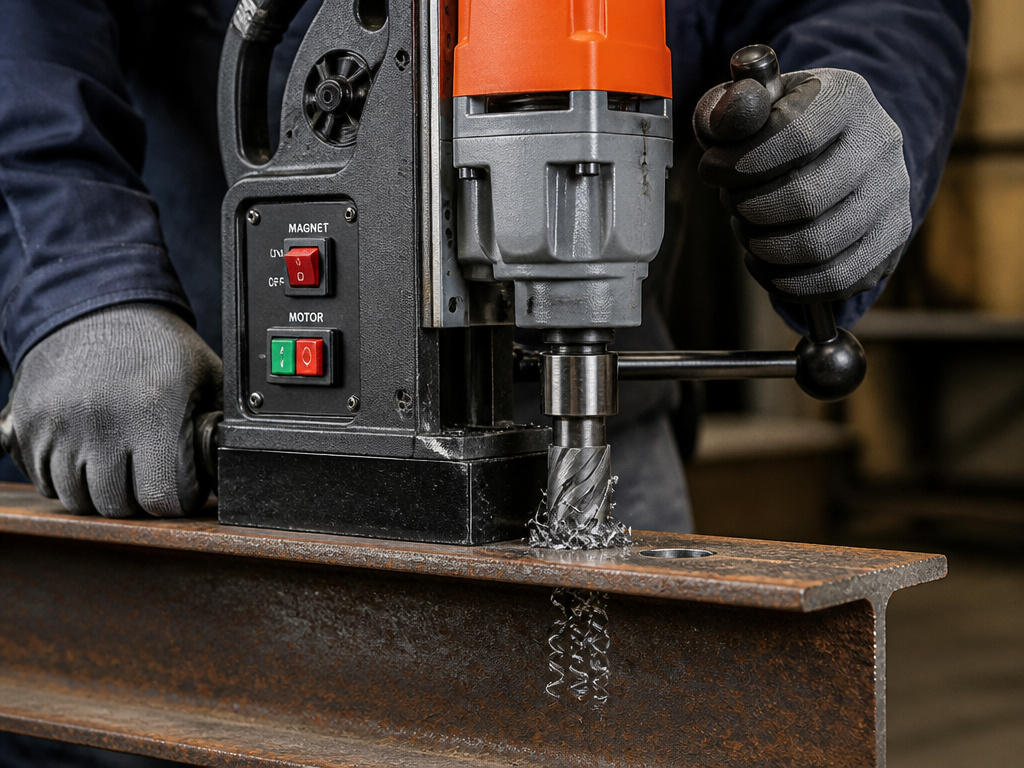
Magnetic drills are specialty tools for specialty jobs. They are not general-purpose drills. Their value appears in four specific fields.
- Structural Steel & Bridge Fabrication: This is the primary domain. Drilling bolt holes in I-beams, columns, and gusset plates on-site or in the shop. The magnet holds the drill perfectly perpendicular to the workpiece, ensuring bolt holes align.
- Shipbuilding & Marine Maintenance: Drilling through hull plates, decking, and structural members where the workpiece is fixed and massive.
- Heavy Equipment Repair & Mining: Performing maintenance and modifications on excavator arms, crusher frames, and conveyor supports in the field.
- Pipeline & Pressure Vessel Work: Drilling mounting or access holes in large-diameter pipes and tanks.
The common thread is ferrous metal that you can’t or shouldn’t move. If you can bring the piece to a stationary drill press, you should. The mag drill is for when the workpiece is the building, the ship, or the machine.
To keep a shop running with these tools, organization is key. Having magnetic tool holders on your welding cart or bench keeps magnetic screwdriver bits and other small steel items instantly accessible, which is a different use of magnetism but speaks to the same efficient workshop philosophy.
Safety Rules You Cannot Bend
This is a YMYL (Your Money, Your Life) tool. Getting it wrong has physical consequences. The manuals from Milwaukee, Bosch, and Hougen all scream the same warnings.
- Always Use a Safety Chain or Harness. This is non-negotiable. Clip it to a secure point on the drill and to the workpiece or a separate structure. If the power fails or the magnet slips, this is the only thing stopping the drill from falling.
- Inspect the Base and Cable Before Every Use. Look for cracks, damaged insulation, or worn spots. A damaged coil can fail under load.
- Never Use on Non-Ferrous Materials Without a Secure Workaround. The magnet provides zero holding force on aluminum, copper, or many stainless steels. Clamp it to a steel backer plate that is itself securely fastened.
- Wear Full PPE. Safety glasses are the bare minimum. Gloves, hearing protection, and a face shield are recommended, annular cutters throw off sharp, hot chips.
- Work in Pairs for Overhead Drilling. The manual for the Milwaukee M18 FMDP states this explicitly. Lifting and positioning these heavy tools alone is a back injury waiting to happen.
Modern tools include safety features like automatic shut-offs. The Bosch GBM 50-2 has a load indicator to prevent motor overheating, and the Milwaukee has an auto-stop that kills power if a sudden high torque could break the magnet’s grip. These are last-line defenses. Your first line is procedure.
Frequently Asked Questions
What is the minimum thickness for a magnetic drill?
You need at least 6mm (1/4 inch) of solid, ferrous steel for the magnet to hold securely. Thinner material risks the tool slipping or detaching under drilling pressure. For sheet metal, always clamp a thick steel backing plate.
Can you use a magnetic drill on aluminum?
No, not directly. The electromagnetic base only adheres to ferrous (iron-containing) metals like steel. To drill aluminum, you must use a vacuum base accessory or mechanically clamp the drill to a steel plate that is itself fastened to the aluminum workpiece.
What is the difference between an annular cutter and a twist drill?
An annular cutter is hollow and cuts only a ring, leaving a solid core slug. It requires less power, produces a cleaner hole, and is the standard for magnetic drills. A twist drill is solid and cuts the entire cylinder of material, requiring more power and producing more heat and chip volume.
Do you need coolant with a magnetic drill?
For prolonged drilling or harder steels, yes. Many mag drills have a built-in coolant reservoir that pumps fluid to the cutter. Coolant reduces heat, extends cutter life, and helps eject chips. For short holes in mild steel, a brush-on cutting oil can suffice.
The Bottom Line
A magnetic drill is a powerhouse for one specific task: drilling large, accurate holes in stationary steel. Its electromagnetic base unlocks a world of overhead, vertical, and on-site work that no other portable tool can match safely. But its utility is bounded by strict physics, the magnet needs thick, clean, ferrous steel to do its job.
Before you consider one, be honest about your materials and your needs. If you’re drilling bolt holes in structural beams or maintaining heavy equipment, it’s an indispensable tool. Look at the Bosch GBM 50-2 for shop power or the Milwaukee M18 FMDP for cordless site work. If your projects are smaller or involve mixed materials, a robust drill bit vs screw bit understanding and a good drill press will serve you better and safer.
