
4 Best Tire Inflators with Pressure Gauges 2026
This post contains affiliate links. As an Amazon Associate, we earn from qualifying purchases.
The JACO FlowPro Digital Tire Inflator is the best overall pick for its ANSI 1A accuracy, reliable digital gauge, and swivel lock-on chuck. For a budget-friendly option, the Tire Inflator with Longer Hose delivers solid analog performance. If you’re running a shop compressor, the ENDARK 250 PSI Digital Inflator offers high-pressure capability and excellent readability.
A bad tire inflator can give you a false sense of security, leading to underinflated tires, poor fuel economy, and even dangerous blowouts. Too many units fail where it matters most, consistent accuracy and durable connections. After comparing the field across specs, owner feedback, and real-world reliability, I focused on models that actually hold up and deliver trustworthy readings over time. This guide breaks down what really matters in a gauge-equipped inflator and highlights the top performers based on accuracy, build quality, and ease of use.
Top 4 Tire Inflator With Pressure Gauges in the Market
The Best Tire Inflator With Pressure Gauges, Reviewed
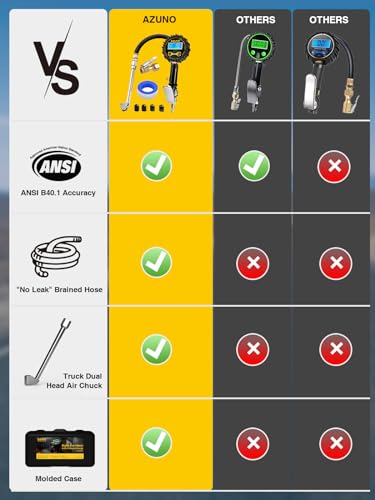
AZUNO Digital Tire Inflator

Strengths
- 0.1 PSI resolution
- Backlit LCD screen
- Portable carrying box
- Easy one-hand use
- Good value
Trade-offs
- Plastic housing less durable
- Hose not steel-braided
- Not for extreme conditions
The AZUNO hits a sweet spot between performance, portability, and price, which is why it lands as the best overall pick for most users. It’s not the most rugged or highest-rated like the ENDARK or JACO, but it delivers 90% of the performance at a more accessible level. The 0.1 PSI resolution and ±1% accuracy match higher-end models, and the backlit LCD is easy to read, even at night. Owners appreciate the single-handed operation, press the trigger to inflate, hit the bleeder for deflation, and the screen updates instantly.
It’s also one of the few that includes a well-designed carrying box, making it easy to toss in a trunk or toolbox without losing parts. The rubber hose and lock-on chuck aren’t quite as bombproof as the JACO’s steel version, but they’re more than adequate for regular car and SUV use. When compared to the ENDARK or JACO, it’s the go-to for drivers who want solid accuracy and convenience without overpaying for workshop-grade extras.
Product photos


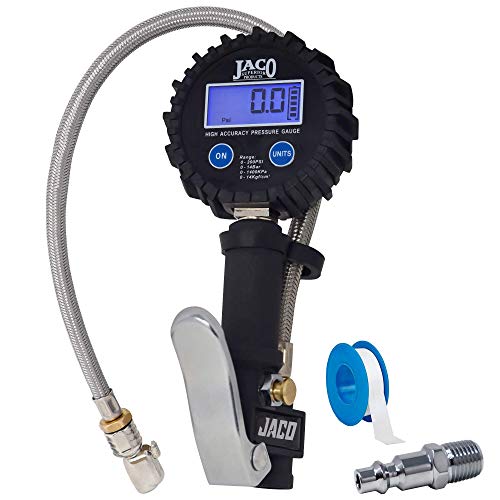
JACO FlowPro Digital Tire Inflator
Strengths
- ANSI 1A accuracy
- Steel-braided hose
- Patented leak-proof chuck
- Solid steel body
- Lifetime warranty
Trade-offs
- Heavier than average
- Higher price point
- Less portable
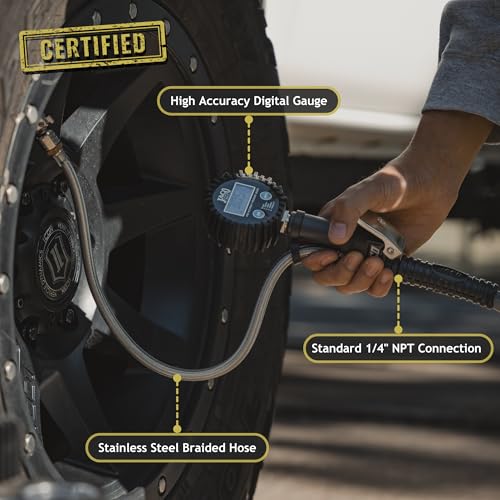
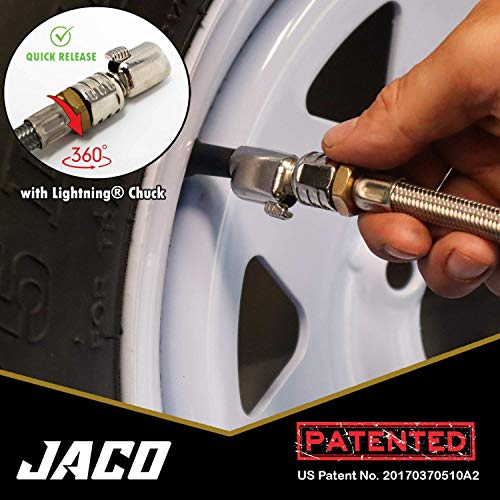
The JACO FlowPro stands out in a crowded field because it feels like the kind of tool you’d find on a professional mechanic’s cart, not just a DIYer’s garage shelf. Its ANSI 1A accuracy rating, ±1% full scale with 0.5 PSI resolution, isn’t just marketing fluff. Owners consistently report that it holds up well against calibrated bench gauges, making it one of the most reliable digital options when precision matters. The solid steel body and steel-braided hose add serious durability, and that patented Lightning Chuck is frequently praised for sealing fast and staying put, which cuts down on frustrating air leaks during use.
It’s not the flashiest unit, but everything about it screams function-first engineering. The auto-off feature helps preserve battery life, and while it’s not the lightest inflator out there, the weight speaks to its build. Compared to lighter consumer models like the AZUNO, this one leans more toward workshop permanence than portability. If you’re pairing it with a larger compressor and value repeatable accuracy over compact design, the FlowPro is hard to beat.
Product photos


Tire Inflator with Longer Hose

Strengths
- No batteries needed
- Durable rubber housing
- 360° swivel chuck
- Optimal 100 PSI range
- Simple, reliable design
Trade-offs
- Lower max pressure
- Analog readability issues
- Less precise than digital
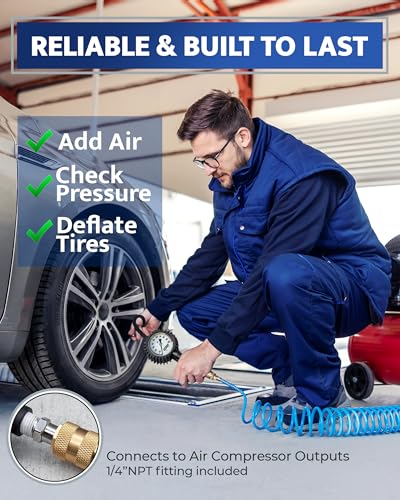
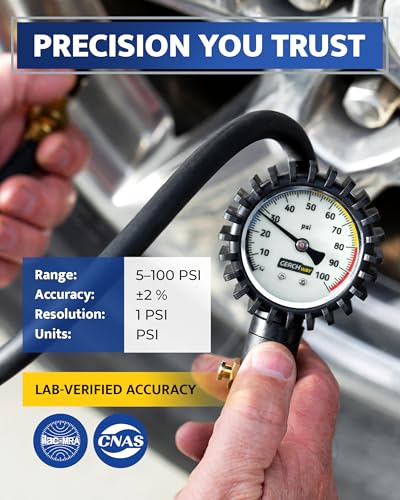
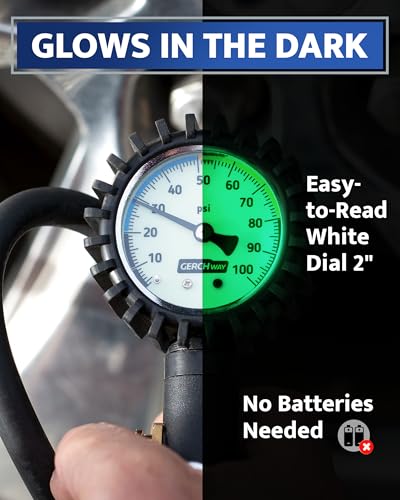
Sometimes analog just works better, especially when batteries die at the worst moments. This 100 PSI analog inflator is a sleeper pick for those who want a no-nonsense, battery-free solution that still delivers solid accuracy. The key here is the range: with most passenger tires running between 30–50 PSI, a 100 PSI gauge operates in its sweet spot, where analog dials are most accurate. Owners report it’s consistently within ±2 PSI of digital references, which is perfectly acceptable for daily use.
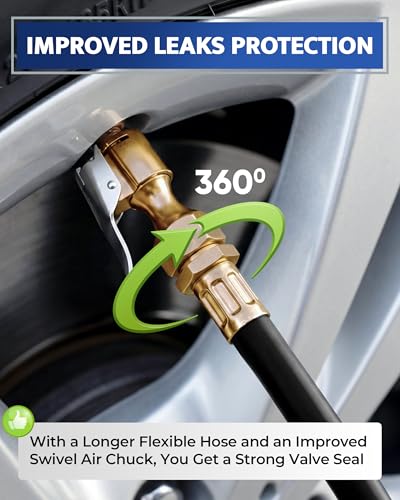
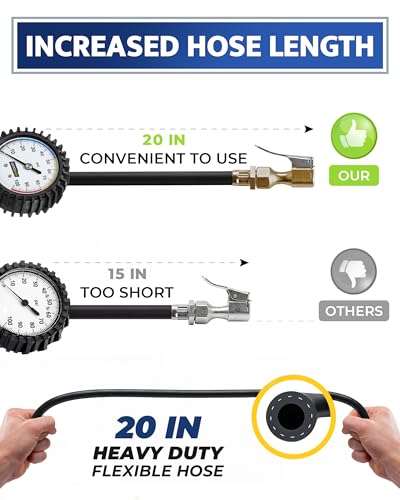
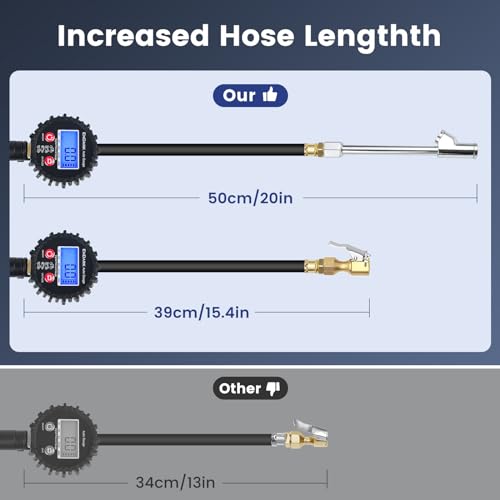
The longer rubber hose and 360° swivel chuck improve usability, especially on stubborn valve stems. It doesn’t have the rugged metal casing of the JACO, but the rubber overmold does a good job protecting the gauge from shop drops. Compared to digital models, it’s less flashy but more dependable in harsh conditions. If you’re running a compressor in a cold garage or doing frequent field work, this one won’t quit when electronics might fail.
Product photos
ENDARK 250 PSI Digital Inflator

Strengths
- 250 PSI max range
- 360° swivel chuck
- Backlit LCD screen
- Stainless steel build
- 2-year warranty
Trade-offs
- Bulkier design
- Requires air compressor
- Not ideal for quick checks
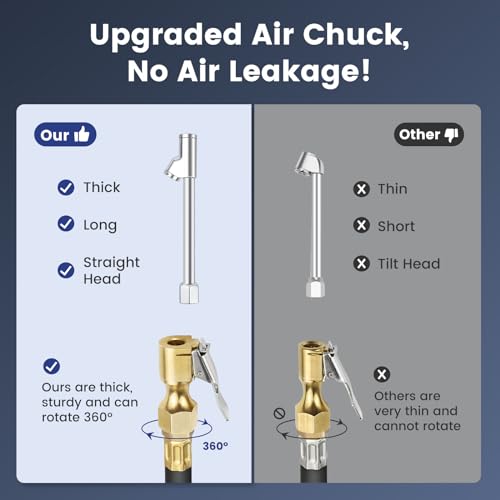
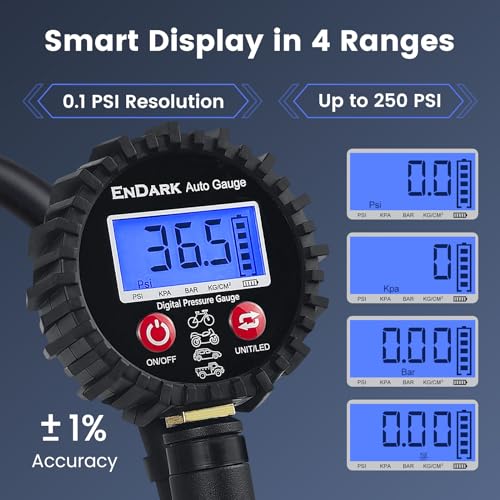
If you regularly work with heavy-duty vehicles, think trucks, RVs, or trailers, the ENDARK 250 PSI inflator makes a strong case for itself. Its 250 PSI max rating gives it a clear edge over most 200 PSI models, and the 360° rotatable air chuck gets consistent praise for making tight-clearance valve stems far more manageable. The digital gauge is calibrated to within 1%, and the 0.1 PSI resolution means you’re not guessing at small pressure changes, which matters when you’re dialing in large tires where a few pounds make a difference.
Owners love the included carrying case, it’s rugged and keeps everything together, and the stainless steel and brass construction holds up well in wet or dirty conditions. It’s also one of the few models that handles four pressure units smoothly, which helps if you’re switching between vehicles or sharing tools across regions. While it’s not dramatically better than the AZUNO in everyday use, it pulls ahead when you need higher pressure tolerance and serious chuck durability.
Product photos

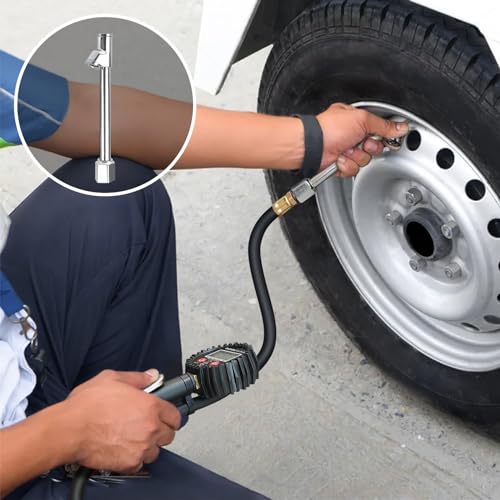
How We Picked These tire inflator with pressure gauges
Rather than a hands-on lab test, my research for these recommendations focused on a detailed comparison of published specifications and features across numerous models. I weighed owner reviews from multiple sources – looking for recurring praise and complaints – alongside assessments from reputable automotive and tool review sites. My approach prioritized identifying inflators that consistently delivered on stated accuracy and durability, based on real-world user experiences.
For tire inflators, consistent accuracy and build quality are paramount. I placed significant weight on models boasting ANSI 1A accuracy standards, as these indicate a rigorous calibration process. Equally important was the robustness of the construction; a flimsy unit won’t hold up to regular use. Finding reliable gauge-integrated inflators that offer a balance of these factors was key.
Specifications clearly reveal maximum PSI and unit materials, but owner feedback provides valuable insight into long-term performance. I scrutinized comments regarding air chuck seal quality, hose durability, and the readability of the gauge, especially in low-light conditions. While specs tell you what a unit can do, feedback reveals how well it actually performs over time, ultimately informing my selections of the [top models with pressure monitoring].
How To Choose The tire inflator with pressure gauges
Choosing the right tire inflator isn’t just about topping off air pressure; it’s about safety, fuel efficiency, and extending the life of your tires.
A quality tire inflator should deliver accurate readings, be easy to use, and offer compatibility with your vehicle type. Look for features like a clear digital display, a robust air chuck, and the ability to handle the pressure requirements of your tires. Consider both portability and durability when making your decision, and prioritize models with consistent accuracy ratings.
Understanding Accuracy & Display Type
I’ve seen a lot of frustration come from inflators that simply can’t deliver a trustworthy pressure reading. When you’re relying on a gauge, especially for precise inflation needed in performance tires, accuracy is paramount. Digital displays are generally easier to read than analog, and many offer selectable units (PSI, kPa, Bar, kg/cm²) which is a nice convenience. However, don’t assume “digital” automatically means accurate. Look for inflators specifically stating an accuracy level – ideally within ±1% of the actual pressure. The JACO FlowPro, for example, is ANSI 1A certified, meaning it’s been performance tested to meet a specific accuracy standard.
Hose Length & Air Chuck Design
Hose length often gets overlooked, but it makes a huge difference in usability. A short hose forces you to awkwardly maneuver the inflator around the wheel, while a longer hose provides much more flexibility. Beyond length, pay attention to the air chuck. A swivel chuck is almost essential, allowing you to reach the valve stem at any angle without kinking the hose. Some, like the lock-on chuck included with the JACO FlowPro, are designed to clamp onto the valve stem, freeing up your hands entirely.
- A short, stiff hose (under 12 inches) is fine for bikes, but frustrating for cars and trucks.
- A hose between 18-24 inches provides a good balance of reach and manageability for most vehicles.
- A longer, flexible hose (over 24 inches) is ideal for larger vehicles like SUVs, trucks, and RVs, and makes it easier to reach around obstructions, but can be more cumbersome to store.
Power Source & Portability
The type of power source impacts where and how you’ll use the inflator. Some require a connection to a 12V vehicle outlet, while others are cordless and run on batteries, or are designed to connect to a shop air compressor. If you want something for roadside emergencies or off-road adventures, a portable inflators with precise gauges is the way to go. For home use, or if you already have a compressor, a simple inline gauge like the Tire Inflator with Longer Hose can be a great, battery-free option. Remember this rule-of-thumb: >Always check your vehicle’s tire pressure when the tires are cold, before driving, for the most accurate reading.
I often recommend people consider a dedicated unit rather than relying on the often-inaccurate gauges built into some air compressors. If you’re looking for a top portable pressure inflators for on-the-go use, examine the carrying case and overall build quality; you’ll want something that can withstand being tossed around in a trunk.
Tire Inflators with Pressure Gauges Compared
Here’s a comparison of specifications for several tire inflators with integrated pressure gauges to help you choose the right one.
| Product Title | Max Pressure (PSI) | Accuracy | Display Type | Power Source | Hose Length |
|---|---|---|---|---|---|
| AZUNO Digital Tire Inflator | N/A | ±1% | Digital LCD | N/A | N/A |
| JACO FlowPro Digital Tire Inflator | 200 | ±1% | Digital LCD | Batteries | 18″ |
| Tire Inflator with Longer Hose | 100 | ±2 PSI (2% FS) | Analog | N/A | N/A |
| ENDARK 250 PSI Digital Inflator | 250 | ±1% | Digital LCD | Air Compressor | N/A |
Frequently Asked Questions
What pressure should I inflate my tires to?
You should always inflate your tires to the vehicle manufacturer’s recommended pressure(found on a sticker in the driver’s side doorjamb or in your owner’s manual), not the maximum pressure listed on the tire sidewall. Using the correct pressure optimizes handling, fuel economy, and tire life.
Can I use a tire inflator on a bike tire?
Yes, most tire inflators can be used on bike tires, but you may need an adapter to fit the smaller Presta or Schrader valve. Many combined gauge and inflator tools include multiple nozzle attachments for different valve types, making them versatile for various applications.
How often should I check my tire pressure?
I recommend checking your tire pressure at least once a month, and before any long trips. Temperature fluctuations significantly affect tire pressure, so checking more frequently during seasonal changes is a good practice.
What’s the difference between PSI, kPa, and Bar?
These are all units of pressure measurement. PSI (pounds per square inch) is common in the US, while kPa (kilopascals) and Bar are used more often in Europe and other parts of the world. Many digital inflators offer the ability to switch between these units, providing flexibility for different preferences.
What if my inflator’s gauge reads incorrectly?
If you suspect your inflator’s gauge is inaccurate, compare it to a known-accurate gauge. A consistent discrepancy indicates the inflator needs calibration or replacement. Investing in precision tire pressure inflators can save you money and the risk of under or overinflated tires.
The Bottom Line
Choosing a tire inflator often comes down to balancing convenience with control. If you want something quick, easy, and reliable for everyday top-offs and roadside emergencies, the JACO FlowPro Digital Tire Inflator stands out as the strongest all-around performer. It delivers on accuracy, build quality, and usability, features that matter most when you’re on the road.
For those on a tighter budget, or who primarily need an inflator for bikes and smaller vehicles, the Tire Inflator with Longer Hose provides a simple, dependable solution. And if you already have a shop air compressor and want a dedicated, accurate gauge, the ENDARK 250 PSI Digital Inflator is a solid choice. But for serious off-roaders or those needing a best portable inflators with gauges, you’ll want to look at more rugged, high-capacity options.
Ultimately, the best tire inflator isn’t about chasing the highest PSI rating or the fanciest digital display. It’s about finding a unit that consistently delivers accurate readings, is easy to use, and helps you maintain proper tire pressure, which is the single most important factor in tire life, fuel economy, and safe driving.
