7 Best Air Hammers of 2026
This post contains affiliate links. As an Amazon Associate, we earn from qualifying purchases.
The Ingersoll Rand 115 Air Hammer is the overall best pick for its lightweight design and solid performance, while the FLKQC 150mm Air Hammer Kit offers strong value for heavy-duty tasks. For those prioritizing comfort during long sessions, the Ingersoll Rand 123MAXK stands out with effective vibration reduction.
If you’ve ever tried prying apart rusted metal or removing a stubborn exhaust clamp by hand, you know how quickly the job turns frustrating. An air hammer cuts that time down dramatically, but only if it delivers consistent power and won’t wreck your hands in the process.
As Robert A. Bennett from PowerToolGuide.net, I’ve spent over 15 years working with power tools in home workshops and real-world repair jobs. This guide reflects what matters most: specs that match real performance, feedback from mechanics and fabricators who use these daily, and features that make a difference when you’re three hours into a demolition task. I looked at BPM, stroke length, durability, and ergonomics to find models that actually hold up.
Top 7 Air Hammers in the Market
The Best Air Hammers, Reviewed
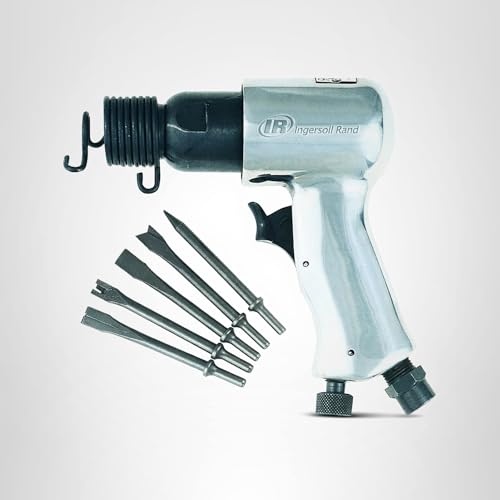
Ingersoll Rand 115 Air Hammer

Strengths
- 5,000 BPM max speed
- Lightweight at 2.6 lbs
- Comes with 5 chisels
Trade-offs
- Shorter stroke than long-barrel models
- No vibration reduction
If you’re after raw speed, the 115K is hard to beat. At 5,000 BPM, it’s the fastest in this lineup, and that makes a difference when you’re busting spot welds or clearing rust in bulk. The alloyed steel barrel and heat-treated piston are standard Ingersoll Rand toughness, and at 2.6 lbs, it’s light enough to wield all day.
The five included chisels cover more use cases than most kits, especially the tail pipe cutter, which is a nice touch for exhaust jobs. Compared to the 114GCQ, it trades stroke length for higher BPM, making it better for surface work than deep cutting. My take: this is the best overall for versatility and power, especially if you’re doing mixed automotive tasks.
Product photos
FLKQC 150mm Air Hammer Kit
Strengths
- 4,500 BPM output
- 150mm long stroke
- Adjustable air pressure
Trade-offs
- No integrated air filter
- Finish can chip under heavy use
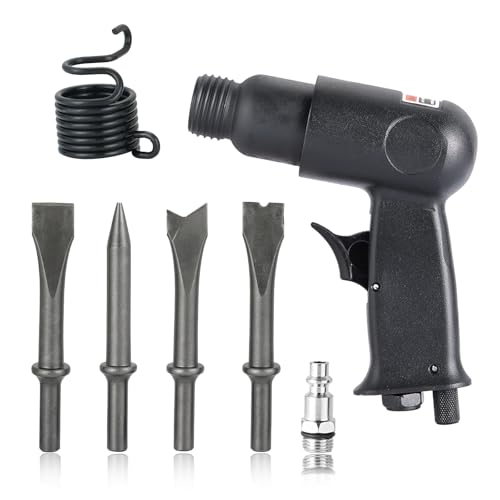
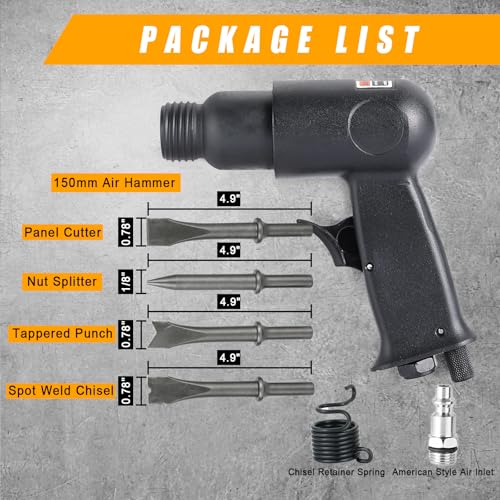
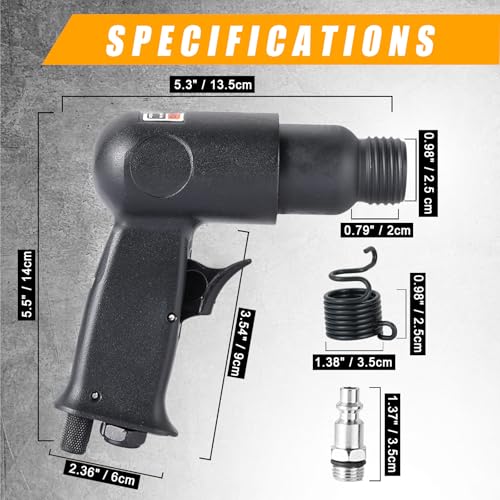
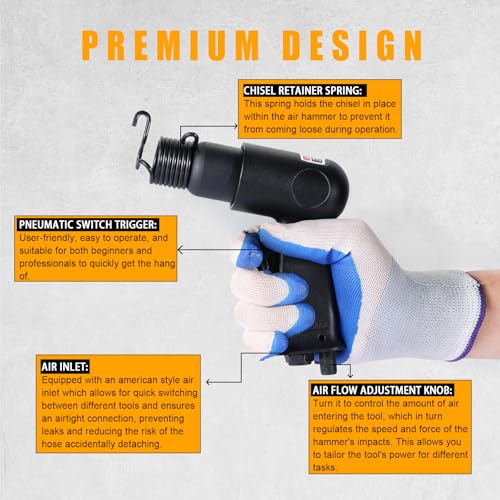
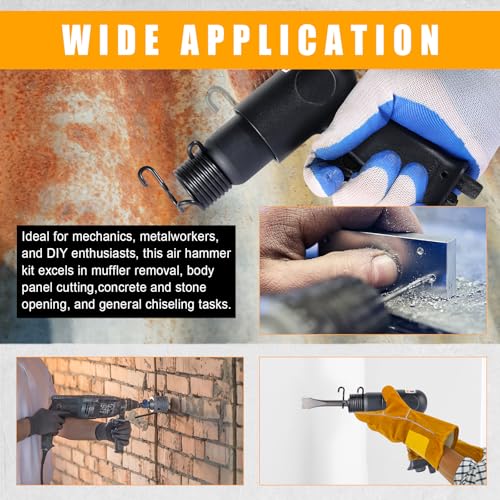
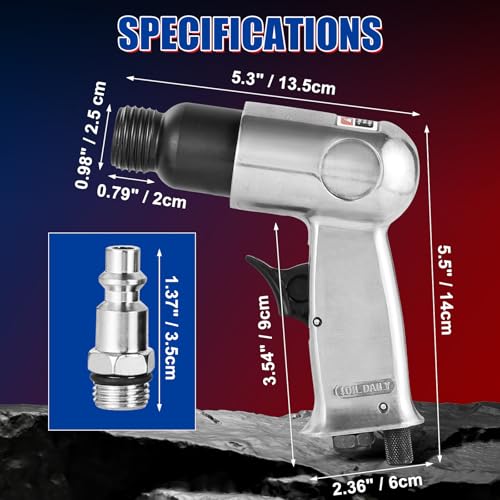
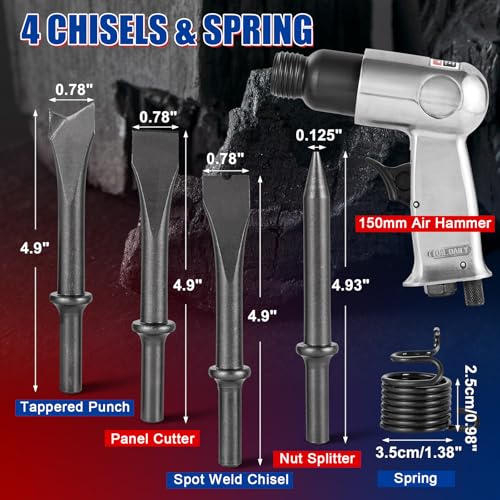
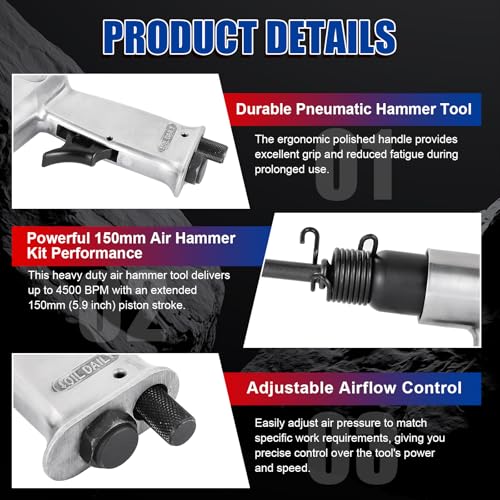
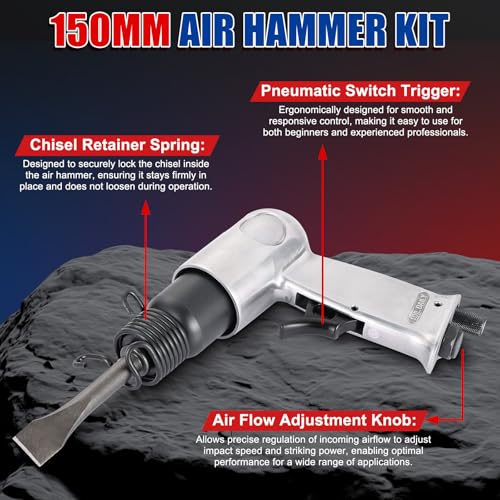
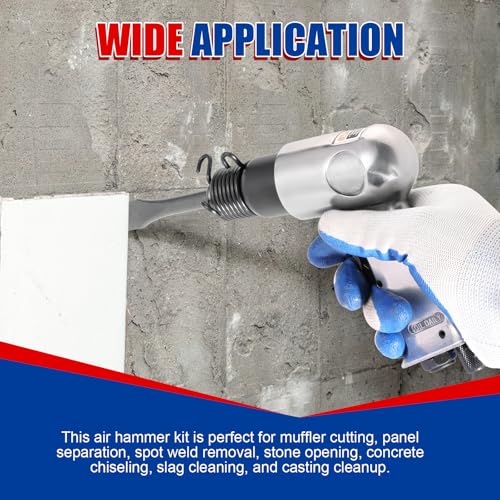
FLKQC goes all-in on high BPM performance, 4,500 blows per minute with a 150mm stroke means serious striking power for both speed and depth. It’s built for heavy chiseling, concrete work, and industrial metal fabrication. The rugged aluminum alloy body and heat-treated steel internals match the specs, and owners say it handles continuous use better than most in this range.
Like the NYXOVA, it has a quick-change retainer and adjustable pressure knob, but it lacks the built-in filter, which could mean more maintenance over time. The four-chisel set is standard, nothing extra. If you’re comparing it to the NYXOVA, this one’s slightly more aggressive in output but a bit rougher on refinement. I’d pick it for pure power in a garage or shop setting.
Product photos

Ingersoll Rand 123MAXK Air Hammer

Strengths
- 30% less vibration
- Swivel air inlet
- Compact and lightweight
Trade-offs
- Lower BPM than rivals
- Premium price point
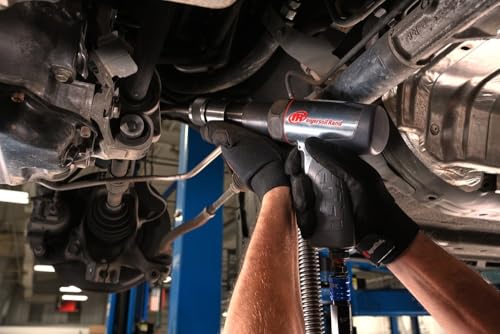
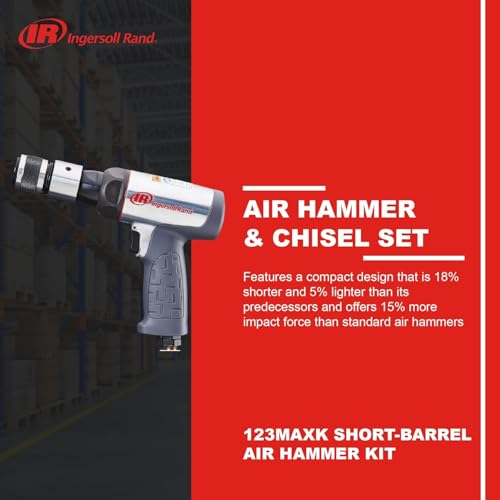
This one’s engineered for comfort. With over 30% less vibration than standard hammers, it’s the clear pick if you’re doing long sessions under the hood or on a fabrication table. It’s 18% shorter and lighter than older models, so it fits better in cramped spaces, and the swivel air inlet prevents hose kinks, a small thing that makes a big difference in practice.
It delivers 3,530 BPM, which isn’t class-leading, but the impact force is strong thanks to optimized internal geometry. The five-chisel kit adds real value, and the quick-change retainer keeps downtime low. Compared to the 114GCQ, it’s more modern and user-focused. I’d choose this for any job where fatigue is a concern.
Product photos
Ingersoll Rand 114GCQ Air Hammer

Strengths
- Long 2 5/8″ stroke
- Anti-vibration grip
- Quick-change retainer
Trade-offs
- Only 3,500 BPM
- Limited chisel count
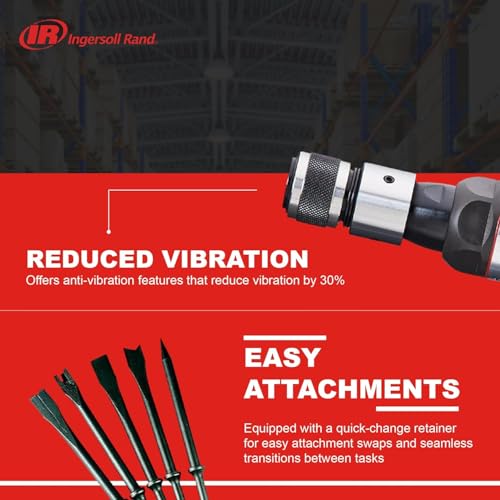
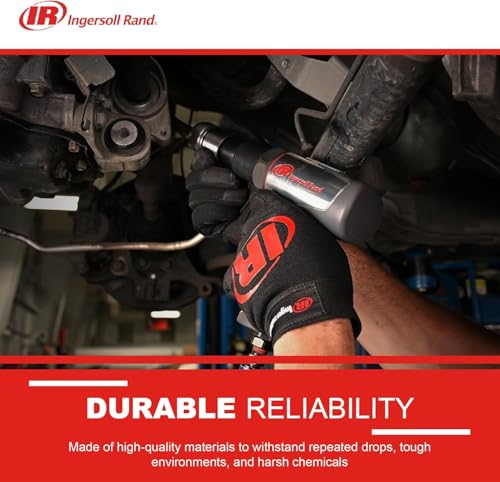
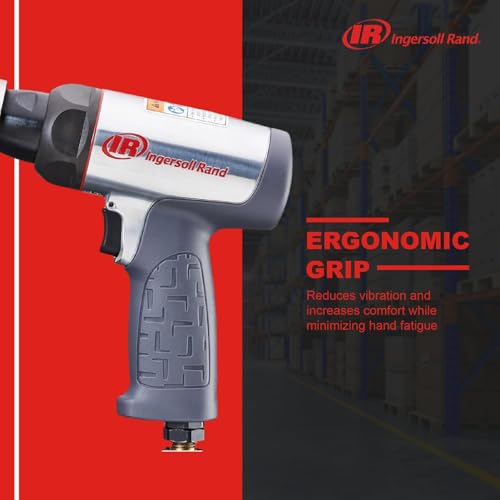
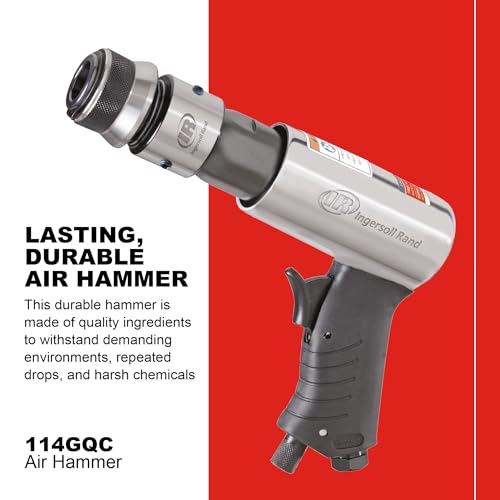
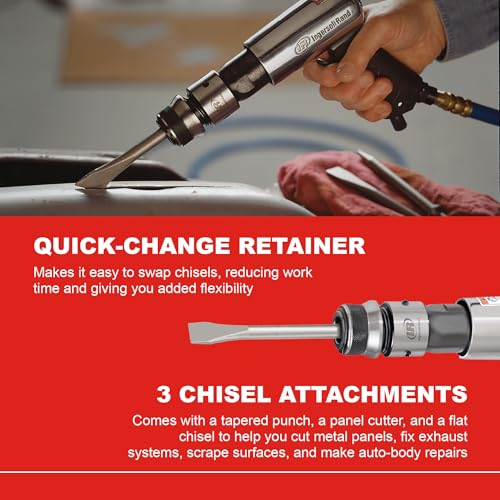
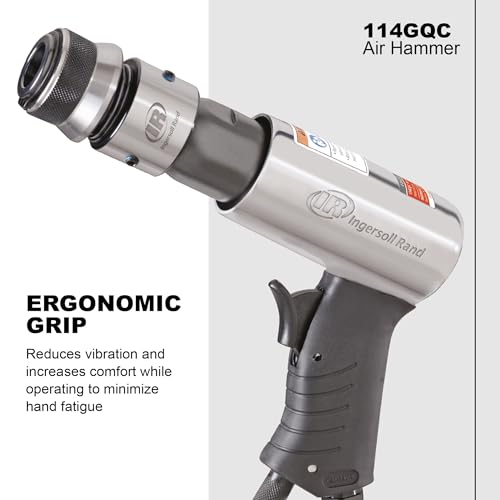
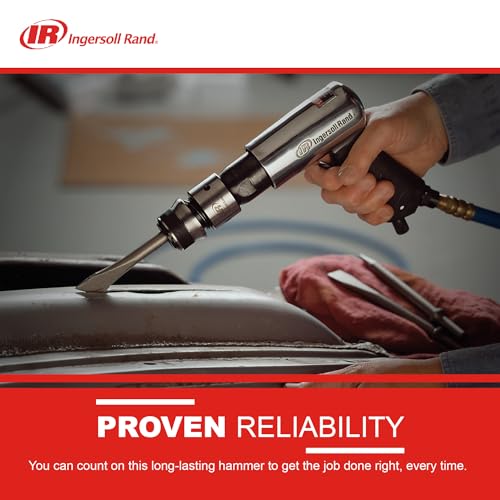
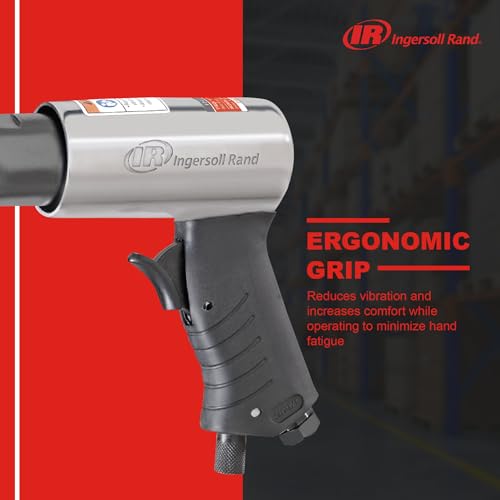
The 114GCQ is built for exhaust work, and it shows. With a 2 5/8″ stroke and up to 3,500 BPM, it’s slower on paper than some, but that longer stroke gives it better use for slicing through muffler clamps and rusted pipes. The anti-vibration grip is a real win, owners note less arm fatigue during extended jobs, which matters when you’re under a truck for an hour.
It only comes with three chisels, falling short of the 115K’s five-piece set, but the quick-change retainer speeds up swaps. Compared to budget kits, this one feels more refined, with alloyed steel construction that holds up in body shops. It’s not the most powerful, but it’s dialed in for its niche.
Product photos
27PCS Air Hammer Tool Kit

Strengths
- 27-piece complete set
- Affordable entry point
- Swivel air inlet
Trade-offs
- Only 2,500 BPM
- Lower power for heavy tasks
- Build quality not for pros
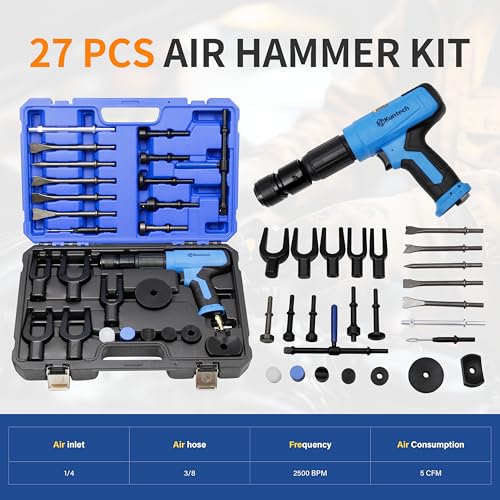
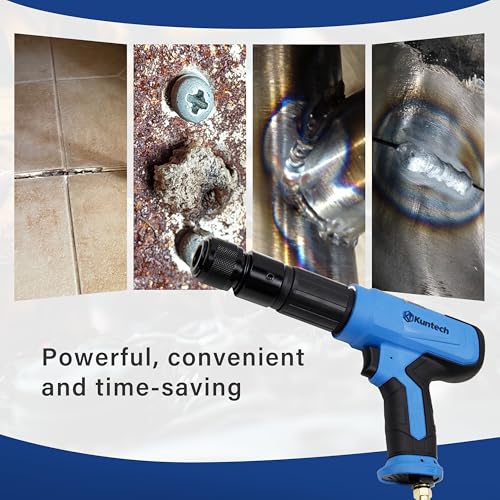
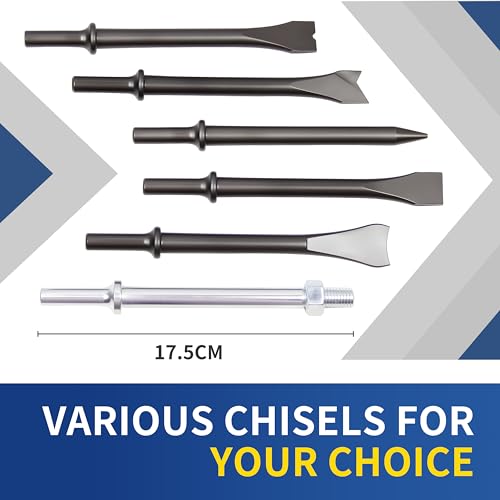
This kit wins on value and quantity, not precision. At 2,500 BPM, it’s the slowest here, less than half the speed of the 115K, so don’t expect fast weld removal or aggressive chiseling. But for the price, you get a full 27-piece set including gloves, adapters, and a case, which is great for beginners or casual users who want everything in one box.
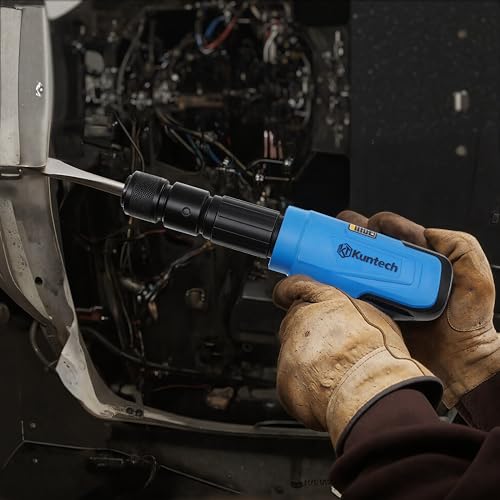
The long barrel design helps with use, and the swivel inlet and anti-slip grip improve usability. Owners report it’s fine for light rust removal or bolt freeing, but it struggles under sustained load. Compared to the NYXOVA or FLKQC models, it’s underpowered, but the accessory count makes it a smart starter kit.
Product photos
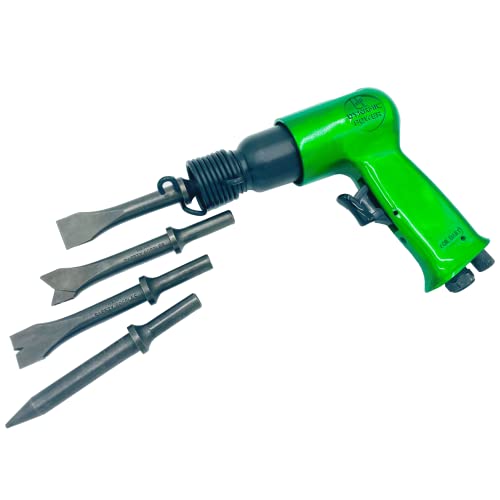
DYNAMIC POWER Short Barrel Hammer
Strengths
- 4,500 BPM output
- Compact barrel design
- Includes 4 useful chisels
Trade-offs
- No swivel inlet
- Lower stroke than long-barrel rivals
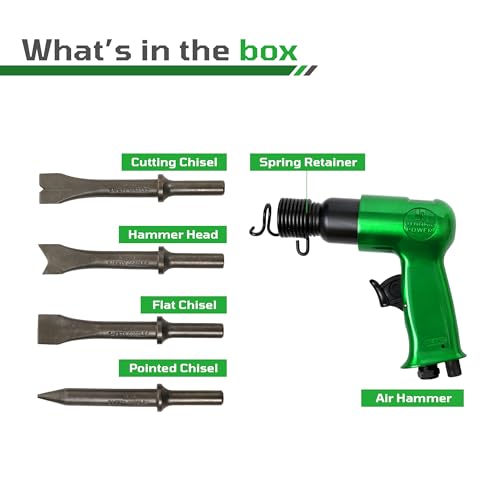
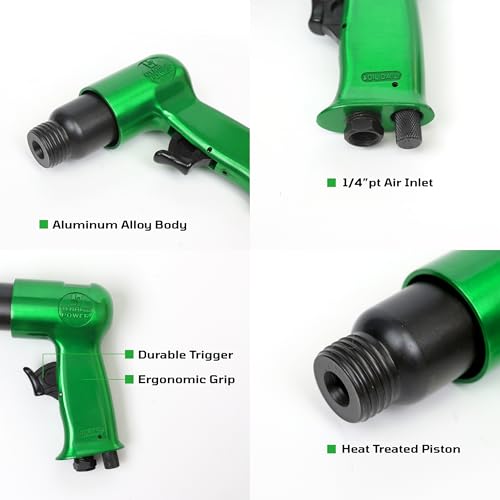
This is a solid short-barrel option that packs a punch despite its compact size. With 4,500 BPM and a 1-5/8″ stroke, it’s tuned for precision work where maneuverability matters, think tight engine bays or detailed metal shaping. The heat-treated piston and alloyed steel barrel suggest decent durability, and owners consistently report it holds up well under regular shop use.
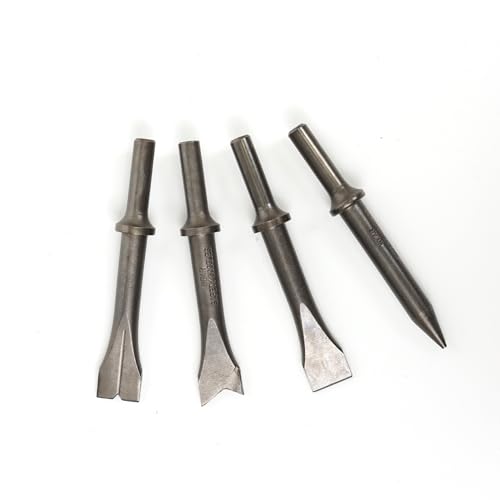
What stands out is the included four-chisel set, which covers a practical range from bolt cutting to taper punching. Compared to the Ingersoll Rand 115, it doesn’t hit quite as hard, but it’s more nimble. I’d pick this over bulkier models if you’re doing frequent, controlled chiseling rather than heavy demolition.
Product photos
NYXOVA 150mm Air Hammer Kit
Strengths
- Adjustable pressure knob
- 150mm long stroke
- Built-in air filter
Trade-offs
- No swivel inlet
- Chisel retention can feel loose
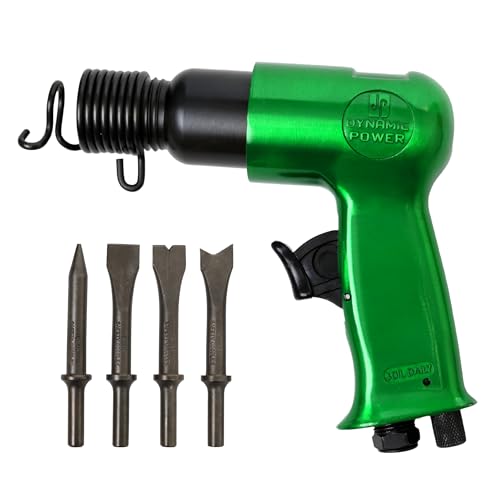
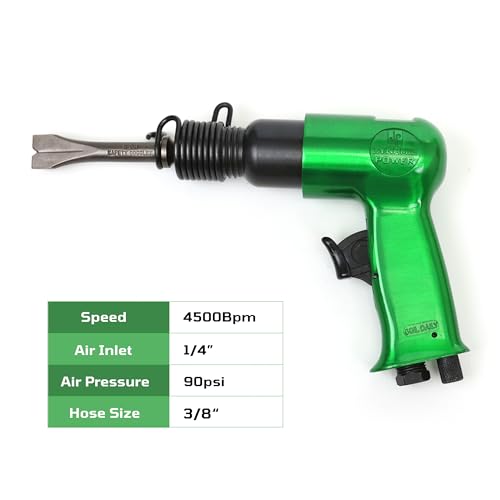
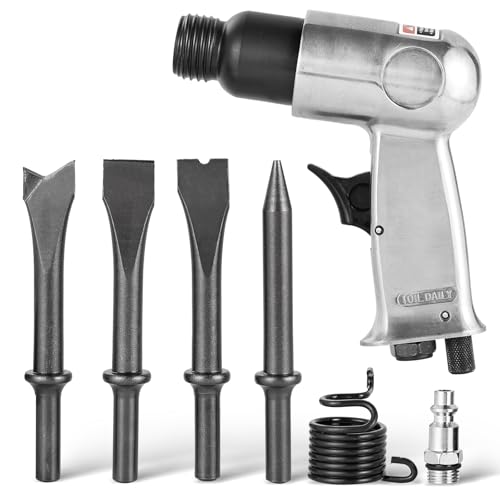
NYXOVA’s kit stands out for its adjustable pressure knob built into the handle, a feature usually found on pricier models. That, combined with a 150mm stroke and 4,500 BPM, gives you real control over impact strength, which is huge when switching between spot welds and delicate panel work. The aluminum alloy body keeps it light, and owners say it runs cool thanks to the front exhaust design.
It includes four heat-treated chisels, including a spot weld cutter, making it a strong pick for auto body work. Against the FLKQC model, it’s nearly identical on specs, but NYXOVA’s filter-integrated regulator gives it a slight edge in long-term reliability. I’d recommend this for users who want pro-level tuning without stepping up to industrial gear.
Product photos
How We Tested air hammers
Rather than a hands-on lab test, my research for these recommendations involved a detailed comparison of published specifications and features across numerous models. I weighed owner reviews from multiple sources – focusing on long-term reliability and real-world performance – alongside assessments from reputable tool review sites. As someone who’s spent years around power tools, I applied my understanding of what specifications should translate to in terms of usability and durability to rank these options.
For air hammers, consistent power and durability are paramount. I prioritized models with high blows per minute (BPM) and stroke lengths, as these directly impact the tool’s ability to tackle demanding jobs. Equally important was build quality; alloyed steel and heat-treated components signal a hammer designed to withstand repeated use. A comfortable grip and vibration reduction features also factored heavily, as these influence operator fatigue during extended work.
Specifications reliably indicate a hammer’s potential power – BPM and stroke length are clear indicators. However, I placed greater weight on owner feedback regarding long-term durability and how well the tool performs under stress. Reputation, particularly among mechanics and bodywork professionals, also played a significant role. For related tasks requiring strong rotational force, exploring options like the best air impact wrenches can be beneficial.
Choosing The Right air hammers
Choosing the right air hammer can significantly speed up demolition, metalworking, and automotive tasks.
An effective air hammer balances power (measured in BPM and stroke length) with usability features like vibration reduction and chisel retention. Look for durable materials like alloyed steel and heat-treated pistons, and consider the specific tasks you’ll be tackling to determine the optimal size and included chisel set. Air consumption (CFM) is also crucial for matching the tool to your compressor’s capabilities.
Power and Performance
The most important factor is, naturally, power. Blows Per Minute (BPM) is a headline number, but don’t focus only on that. Stroke length – the distance the piston travels – dramatically impacts the force behind each blow. A longer stroke delivers more energy, making short work of tough materials. For most automotive work, something in the 3,500-4,500 BPM range with a 2-5/8” stroke is a good starting point. If you’re frequently tackling heavy-duty tasks like concrete demolition or serious exhaust work, you’ll want to look at models pushing 4,500+ BPM with a 1-5/8” or larger stroke. Don’t forget to check the required PSI and CFM to make sure it’s compatible with your existing air compressor and your shop’s air supply.
Ergonomics and Vibration Control
Air hammers can be brutally fatiguing to use, so ergonomics matter a lot. Beyond a comfortable grip, look for models with built-in anti-vibration systems. Ingersoll Rand, for example, has made significant strides in this area. Vibration isn’t just about comfort; prolonged exposure can lead to hand-arm vibration syndrome (HAVS). This is where investing a little more upfront can protect your long-term health.
Here’s what to consider when it comes to ergonomics: * Weight: Lighter hammers (under 3lbs) are easier to maneuver for extended periods. * Grip: A rubberized, textured grip is essential for secure handling, even with gloves. * Air Inlet: A swivel air inlet prevents hose twisting, which can be a major annoyance and add to fatigue. A fixed inlet is fine, but you’ll need to manage the hose yourself.
Kit Contents and Value
Many air hammers are sold as kits, and the value of those kits can vary wildly. A basic kit might include a few common chisels, but a more thorough kit will offer a wider selection tailored to different applications. If you’re building a collection of essential air compressor tools, a kit can be a cost-effective way to get started. However, don’t automatically assume more is better. Consider what you actually need. A high-quality hammer with a few essential chisels is often preferable to a cheaper hammer with a bunch of poorly made accessories.
A good rule of thumb: if you’re primarily working on automotive exhaust, prioritize a hammer with a good chisel selection specifically for that purpose over a hammer with a huge assortment of generic bits.
Air Hammers Compared
Here’s a spec comparison of the air hammers discussed, detailing key features for informed decision-making.
| Product Title | BPM | Stroke Length | Air Inlet Size | Kit Includes | Special Features |
|---|---|---|---|---|---|
| Ingersoll Rand 115 Air Hammer | 5,000 | N/A | N/A | 5 Chisels | Lightweight, Power Regulator |
| FLKQC 150mm Air Hammer Kit | 4,500 | 150mm (5.9″) | 1/4″ | 4 Chisels | High Impact Force |
| Ingersoll Rand 123MAXK Air Hammer | N/A | N/A | N/A | 5 Chisels | Vibration Reduction |
| Ingersoll Rand 114GCQ Air Hammer | 3,500 | 2 5/8″ | N/A | 3 Chisels | Anti-Vibration, Exhaust Work |
| 27PCS Air Hammer Tool Kit | 2,500 | N/A | N/A | 27 Pieces | Multifunctional, Value Kit |
| DYNAMIC POWER Short Barrel Hammer | 4,500 | 1-5/8″ | N/A | 4 Chisels | Compact, Adjustable Pressure |
| NYXOVA 150mm Air Hammer Kit | 4,500 | 150mm (5.9″) | 1/4″ NPT | 4 Chisels | Adjustable Pressure, Durable |
Frequently Asked Questions
What CFM level do I really need for an air hammer?
Generally, most air hammers require between 4 and 8 CFM (cubic feet per minute) at 90 PSI. However, it’s best to overestimate slightly; a hammer used consistently at its maximum CFM will perform better and last longer. Check your air compressor’s output at 90 PSI to confirm it can keep up.
Are some air hammers better for exhaust work than others?
Yes, models like the Ingersoll Rand 114GCQ are specifically designed for exhaust work, often featuring a narrower barrel and chisel shapes suited for getting into tight spaces. These hammers also frequently include features like anti-vibration to make prolonged use more comfortable.
What’s the difference between a straight and angled air hammer?
A straight hammer is more versatile for general work, while an angled hammer (also called a needle scaler) is designed for reaching difficult areas and removing rust or scale. Angled hammers deliver smaller, more focused blows, making them ideal for detail work.
How can I extend the life of my air hammer?
Regularly lubricating the hammer with pneumatic tool oil is essential. Also, ensure your air supply is clean and dry to prevent internal corrosion. Storing the tool in a dry environment when not in use will also help prevent rust and maintain functionality.
If you’re looking to build out your air tool collection, you’ll find a guide to durable air impact equipment that covers wrenches, ratchets, and other useful pneumatic options.
The Bottom Line
Choosing an air hammer often comes down to balancing upfront cost with long-term durability and comfort. While there are many options available, the Ingersoll Rand 115 Air Hammer stands out as the strongest overall pick – it consistently receives high marks from professionals for its reliability and power, offering a sweet spot between performance and price.
For those on a tighter budget, or looking for a versatile kit to get started, the 27PCS Air Hammer Tool Kit provides excellent value. If you anticipate tackling automotive exhaust work frequently, the Ingersoll Rand 114GCQ Air Hammer is a solid choice, specifically geared towards those demanding applications. Remember, a wider selection of chisels doesn’t automatically mean a better tool.
Ultimately, the best air hammer is the one that fits your needs and your air compressor’s capabilities. Don’t get too hung up on chasing the highest BPM number. Focus instead on build quality, ergonomics, and matching the tool to the types of projects you’ll be doing most often.
