What Is a Step Drill Bit Used For? Metal & Sheet Metal Uses
This post contains affiliate links. As an Amazon Associate, we earn from qualifying purchases.
A step drill bit is a cone-shaped cutting tool used to drill clean, accurately sized holes in thin sheet metal, plastic, and wood without creating burrs or requiring a pilot hole. Its stepped design lets you drill multiple hole diameters with one bit, and its geometry shears material cleanly instead of tearing it.
That clean cut is the whole point. On sheet metal, a standard twist bit grabs and deforms the material, leaving a jagged edge you have to file down. A step bit slices through it. The steps act as built-in stops, so you can drill to an exact diameter every time.
What follows is a breakdown of where this tool wins, where it fails, and the specs that decide whether a Hilti, Klein, or ITM model is the right pick for your shop. By the end, you’ll know exactly when to pull a step bit from the case instead of a standard drill bit.
Key Takeaways
- Step bits excel in thin materials, sheet metal, plastic, electrical boxes, where clean edges matter more than deep penetration.
- The coating (AlTiN, TiN) isn’t for show; it directly impacts heat resistance and can extend bit life by 5x in metal.
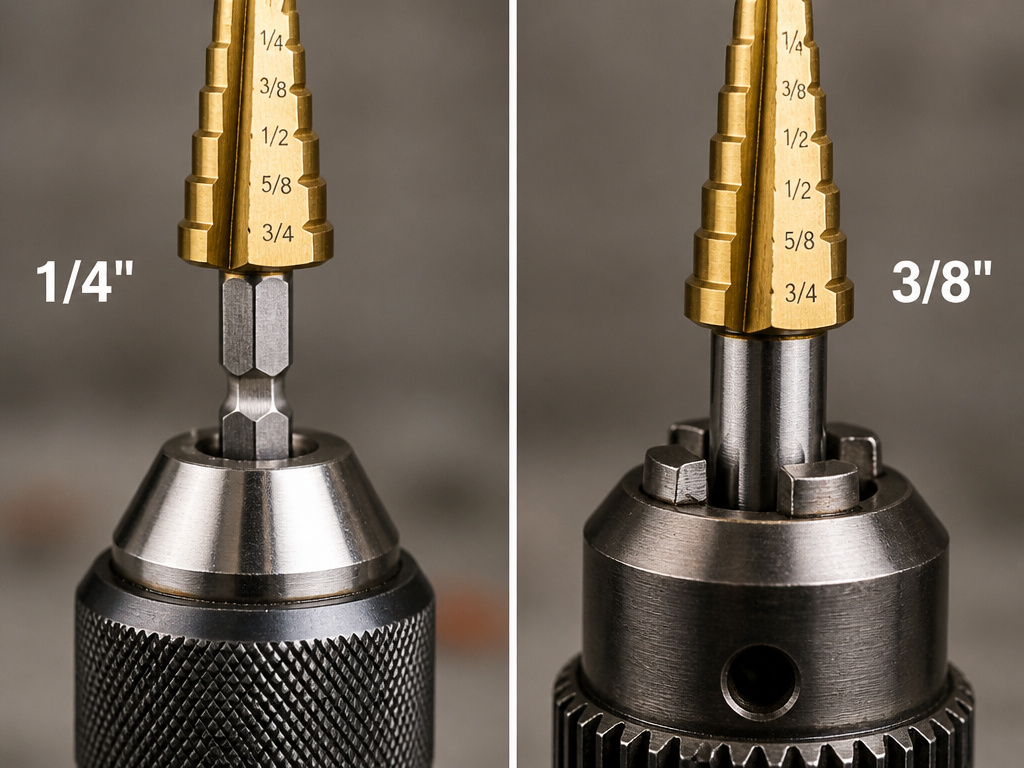
- Shank type dictates your tool: a 1/4″ hex shank works in an impact driver; a 3/8″ round shank needs a drill chuck.
- There’s a hard thickness limit, usually 3/8″ (9.5 mm) for mild steel; pushing past it snaps the tip.
- For electrical and metalworking, a step bit isn’t just convenient; it’s often the only tool that leaves a hole ready for a fastener without secondary finishing.
The Core Job of a Step Drill Bit
A step drill bit has one primary mission: to make clean, burr-free holes in thin, ductile materials without walking. The stepped cone design isn’t a gimmick. Each step is a cutting edge with a specific diameter. As you press the bit into the material, the first (smallest) step drills a pilot hole. The next step enlarges it, and so on.
Step Drill Bit Technical Profile: A conical cutting tool fabricated from high-speed steel (HSS) with multiple graduated cutting edges. Each step corresponds to a precise hole diameter, eliminating the need for multiple twist bits. Common shank types include 1/4-inch hex for impact drivers and 3/8-inch round for drill chucks. Maximum effective material thickness is governed by the step height, typically capping at 3/8 inch (9.5 mm) for mild steel.
This mechanism is why it dominates sheet metal work. A twist bit‘s flutes are designed to evacuate chips from a deep hole. In thin sheet, they often grab and spin the workpiece, or worse, tear through and leave a dangerous, sharp burr. A step bit’s cutting action is a shear. It slices a clean ring out of the material.
The steps also solve the problem of hole sizing. Need a 1/2-inch hole for a conduit knockout? Drill until the 1/2-inch step reaches the material’s back side. Need to enlarge it to 3/4 inch later? Just drill a little deeper. This repeatable accuracy is why electricians and HVAC technicians rely on them for panel boxes and ductwork.
Where this goes sideways: Using a step bit on material thicker than its rated capacity. The ITM Kwik Stepper datasheet clearly states it cuts up to 3/8″ (9.5 mm) mild steel. Force it into 1/2-inch plate, and the tip’s small cross-section bears all the torque. It snaps flush with the workpiece, and you’re now extracting a broken tool steel plug from your project.
Step Drill Bit vs. Twist Bit: The Real Difference
This is about having the right tool for the physical problem in front of you, not about having more tools. The difference is in the cut and the cleanup.
A standard twist drill bit is a compromise. It’s designed to drill a wide range of materials at various depths. Its pointed tip wants to “walk” on curved surfaces, and its spiraling flutes can lift and distort thin sheet metal. When it breaks through, it almost always leaves a burr, a sharp, raised edge that requires a deburring tool or file to remove safely.
A step drill bit is a specialist. Its broad, flat cutting edges and shallow flute geometry provide maximum support directly behind the cut. This stops the material from deflecting. The shearing action produces a clean hole, often with a minimal burr that’s easily knocked off with a twist of the wrist.
| Aspect | Twist Drill Bit | Step Drill Bit |
|---|---|---|
| Primary Use | Deep holes in wood, plastic, thick metal | Clean holes in thin sheet metal, plastic, electrical boxes |
| Edge Quality | Often creates significant burrs, especially in metal | Produces a clean, sheared edge with minimal burring |
| Hole Sizing | Requires a separate bit for each diameter | Multiple diameters (steps) on a single bit |
| Pilot Hole Needed? | Usually, especially for larger diameters | Self-piloting; the tip starts the hole |
| Best Tool For | Drilling into lumber, masonry, thick steel plate | Electrical work, HVAC, automotive sheet metal, plumbing |
The choice becomes obvious in practice. Installing a new outlet? A step bit makes the knockout in the metal box smooth and perfect for the connector. Trying the same with a twist bit risks chewing up the box and leaving sharp edges that can strip wire insulation.
What Materials Can You Actually Drill?
The product sheets from Hilti, Klein, and ITM are specific. They tell you what the tool is engineered for, and more importantly, what its limits are.
Thin Metal is King: This is the core domain. We’re talking: * Sheet steel (up to 10-gauge or 3/8″ for mild steel, per ITM specs) * Stainless steel sheet (note: Hilti specifies their bits for stainless only with “SF tools”, standard drill drivers, not impacts) * Aluminum sheet and extrusions * Copper and brass sheet
Plastic and Wood: Step bits work beautifully here, especially for enlarging existing holes or creating clean holes in acrylic, PVC, or thin plywood. They prevent the splintering and grabbing common with twist bits.
What It Cannot Do:
- Masonry or Concrete: The cutting edges are not carbide-tipped and will dull immediately.
- Hardened Steel: The HSS material isn’t hard enough.
- Materials Thicker Than the Step Height: This bears repeating. If you need a 1/2-inch hole in 3/4-inch thick stock, a step bit is the wrong tool. You need a twist bit or a hole saw.
Common mistake: Assuming a “metal” rating means all metal. The Hilti impact-ready bit listing separates “Stainless steel” from “Steel” and adds a crucial note: “stainless steel applications are possible only with SF tools.” Using that bit in an impact driver on stainless will likely overheat and ruin it quickly.
Anatomy & Specs: How to Pick the Right One
Not all step bits are the same. The specs on the package are a direct map to performance and compatibility, not marketing.
Shank Type: This Dictates Your Power Tool
- 1/4-inch Hex Shank: Found on models like the Klein Tools QRST03 or the VACO 25962. This shank locks directly into an impact driver or a drill with a hex chuck. It’s the go-to for quick, handheld work.
- 3/8-inch Round Shank: The traditional style, like the ITM Kwik Stepper 34403. It requires a standard drill chuck. It often provides more stability for precise, press-based drilling.
Coating: The Layer That Determines Lifespan
The coating is a wear surface, not just color. * AlTiN (Aluminum Titanium Nitride): The high-end option. Klein claims its AlTiN coating is “10 times more durable than steamed black oxide.” Hilti cites a “5x more holes” lifespan with its similar AlTiN coating. This is for serious, frequent metal drilling. * TiN (Titanium Nitride): The gold-colored coating. It reduces friction and heat, extending life over uncoated bits. Common on mid-range bits like the VACO series. * Black Oxide: A basic rust-inhibiting and mild lubricating finish. It’s for occasional use and non-ferrous materials.
Size Range and Steps
This is the “what size holes can I make?” answer. Bits are defined by their smallest and largest step. * Small (Electrical): 1/8″ to 1/2″ (e.g., Klein QRST01). Perfect for wiring knockouts. * Medium (General): 1/4″ to 3/4″ (e.g., Klein QRST03). The most versatile for conduit, plumbing, and general fab. * Large (HVAC/Plumbing): 7/8″ to 1-3/8″ (e.g., Klein QRST15). For drain lines, venting, and larger pipe.
The Pro Technique: How to Use One Correctly
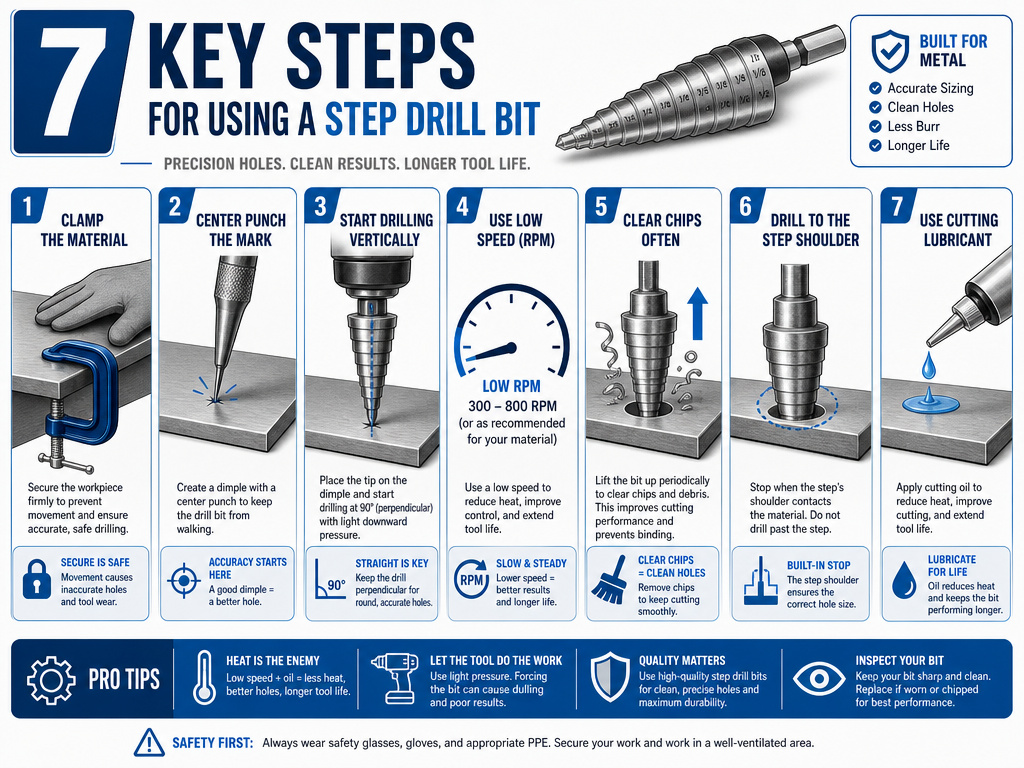
Using a step drill bit is straightforward, but a few nuances prevent broken bits and bad holes.
- Secure the Workpiece. This is non-negotiable with metal. Use clamps. The shearing action can still grab, especially on the final breakthrough.
- Mark Your Center. Use a center punch for metal. The split-point tip on most bits will seat into the dimple and prevent walking.
- Start Slow and Vertical. Begin at a low RPM with firm, steady pressure. Let the tip establish the hole. Keep the drill perfectly perpendicular.
- Apply Steady Pressure, Not High Speed. High RPMs generate heat, which softens the HSS and dulls the edge. Let the cutting geometry do the work. You’ll feel and hear a consistent shearing sound.
- Clear Chips Frequently. Pull the bit out partially every few seconds to clear metal shavings. Packed flutes increase heat and friction.
- Stop at the Step. Drill until the shoulder of the desired step diameter touches the material. Don’t try to force the next step to start; you’ll work-harden the metal and strain the bit.
- Use Cutting Fluid for Steel. Especially for stainless steel or multiple holes. A drop of oil dramatically reduces heat and extends bit life.
Where this goes sideways: Using an impact driver on full power. While hex-shank bits are “impact-rated,” the hammering action is for driving screws, not drilling. For drilling, use the drill-only mode or a standard drill driver. The constant impacting can fracture the cutting edges on the steps over time.
When to Choose a Step Bit Over Other Tools
Your tool choice should match the job’s requirements for finish, speed, and accuracy.
Choose a Step Bit When:
- You need a clean, burr-free hole in thin metal (e.g., for a bolt that needs to sit flush).
- You are enlarging an existing hole (e.g., going from 1/4″ to 3/8″). The steps guide the cut perfectly.
- You need multiple, precise hole sizes but want to carry only one bit.
- You are working with soft materials like plastic or aluminum where tear-out is a concern.
Stick with a Twist Drill Bit When:
- The material is thicker than 3/8 inch.
- You are drilling into wood, masonry, or ceramic.
- You need a very deep hole.
- You only need one hole size and already have the correct twist bit.
Use a Hole Saw When:
- The hole diameter is larger than 1-3/8 inches (the max for most step bits).
- You are cutting through thick stock (like a 2×4).
- The material is very abrasive (like fiber cement board).
For the home workshop tackling metal projects, a medium-range step bit like the Klein QRST03 or a VACO 25963 is the first specialist bit to buy after your standard twist set. It solves problems other tools create.
Frequently Asked Questions
Can you use a step drill bit in an impact driver?
Yes, but only if it has a 1/4-inch hex shank and is marketed as impact-ready. However, for the actual drilling operation, switch the impact driver to its “drill-only” mode if it has one. The hammering mechanism is unnecessary for drilling and can damage the bit’s cutting edges.
Why is my step drill bit getting stuck?
The most common cause is dulling. A dull bit requires more pressure, generates more heat, and the metal can gall and weld to the edges. The second cause is not clearing chips. The flutes pack with material, creating massive friction. Stop, pull the bit out, and clear the chips with a brush or air.
How do you sharpen a step drill bit?
You generally don’t. The complex, stepped geometry makes sharpening impractical with standard tools. Professional sharpening services have specialized fixtures for it, but the cost often approaches that of a new mid-range bit. For a heavily used bit, replacement is the more economical path.
What does the coating color mean?
Gold typically indicates a Titanium Nitride (TiN) coating for reduced friction. A dark gray or black color is usually a wear-resistant Aluminum Titanium Nitride (AlTiN) coating. A plain steel or dark oxide finish is an uncoated or basic black oxide bit. The coating directly correlates to heat resistance and lifespan in metal.
Are step drill bits only for metal?
No. They are excellent for plastic, wood, and laminates where a clean edge is desired and tear-out is a risk. They are often the best tool for drilling holes in PVC pipe or acrylic sheets without cracking or chipping the material.
The Bottom Line
A step drill bit is a specialist you call in for a specific class of problem: clean, accurate holes in thin materials, not a replacement for your standard drill bits. Its value isn’t in doing everything, but in doing one thing exceptionally well where other tools fail.
For metal fabrication, electrical work, or any project involving sheet goods, it’s indispensable. Skip the bargain-bin set. Invest in a single quality bit with an AlTiN coating in the size range you use most, like the Klein Tools QRST03 for general work. It will outlast a cheap set ten times over and deliver professional results every time you pull the trigger.
