
What Are Left Handed Drill Bits Used For? A Practical Guide
This post contains affiliate links. As an Amazon Associate, we earn from qualifying purchases.
Left handed drill bits are for removing broken bolts, screws, and studs. They spin counterclockwise, so as you drill into the broken fastener, the reverse rotation can catch and unscrew it, often eliminating the need for a separate extractor. They are also used in specialized machinery with reverse-spindle motors and for tapping left-hand threads.
That counterclockwise twist is the whole game. It turns a drilling operation into an extraction attempt before you even reach for the extractor set.
What follows is the breakdown of how that works on a mechanical level, the exact specs that matter when you pick one, and the three scenarios where a left-hand bit is the only tool that makes sense. By the end, you’ll know whether to reach for a Cleveland left-hand jobber or a Chicago-Latrobe model, and the one critical mistake that sends metal shards across your shop.
Key Takeaways
- Left-hand bits spin counterclockwise to unscrew broken fasteners as you drill, often solving the problem before an extractor is needed.
- The 135° split point on bits like the Lawson model prevents “walking” and is superior for starting on curved bolt heads.
- Using a left-hand bit on a drill set to forward (clockwise) rotation will only tighten the broken fastener, making the problem worse.
- These bits are governed by specific standards like DIN 338 and ANSI, which dictate tolerances for diameter and flute length.
- They are a specialized tool for extraction and reverse-thread applications, not a replacement for your standard drill bit set.
The Core Principle: Counterclockwise Rotation
Look at the business end of a left-hand drill bit. The flutes spiral to the left. When your drill’s chuck turns counterclockwise, those flutes pull the bit into the material. This is the opposite of every standard drill bit in your kit.
A left-hand spiral drill bit, when rotated counterclockwise, engages the workpiece and evacuates chips up the flute. This rotation direction is defined by standards like DIN 338 for left-hand drilling tools.
That reverse bite is what makes it an extractor. Most bolts and screws are installed with clockwise rotation. When one snaps off, the remaining threads are still oriented to be loosened by a counterclockwise force. A left-hand bit applies that exact force as its cutting edges drill into the bolt’s center.
If you run your drill in forward, you’re just tightening the remnant. Always double-check your drill’s direction setting. The bit should be spinning to the left when you look at the tip.
Left-Hand vs. Right-Hand: The Head-to-Head
This isn’t about preference. It’s about matching rotation to purpose. A standard right-hand bit is for making holes. A left-hand bit is for solving problems.
| Feature | Right-Hand Drill Bit | Left-Hand Drill Bit |
|---|---|---|
| Standard Rotation | Clockwise | Counterclockwise |
| Primary Function | Drilling new holes | Removing broken fasteners, specialized reverse drilling |
| Effect on a Stuck Bolt | Tightens it further | Can unscrew it during drilling |
| Common Point Angles | 118° or 135° | 118° or 135° |
| Typical Use Case | 90% of drilling tasks | Extraction, left-hand thread tapping, specific machinery |
The flutes are mirror images. A right-hand bit’s spiral is designed to push chips out and away from the motor as it drills forward. A left-hand bit’s spiral pulls chips in and up toward the motor when spinning in reverse. Using the wrong bit for the rotation wastes energy, clogs the flutes, and produces a terrible cut.
The Two Real-World Jobs for a Left-Hand Bit
1. Extracting Broken Fasteners (The Main Event)
This is why you buy the set. The process leverages the bit’s rotation to do two jobs at once: create a pilot hole for an extractor and attempt to back the bolt out.
Step-by-Step for Bolt Removal:
- Center Punch: Hit the exact center of the broken bolt. Off-center drilling guarantees failure and damages the parent material.
- Start Small: Use a small-diameter left-hand bit (like a 5/64″ model) to establish a pilot hole. This concentrates torque and increases the chance of the bit catching the bolt’s remnants.
- Slow Speed, High Torque: Set your drill to its lowest speed and highest torque setting. You need rotational force, not RPMs.
- Apply Steady Pressure: Drill into the bolt with the drill in reverse. Listen and feel. If the bit catches, the bolt will often start to turn and back out. If it doesn’t, you’ve now created a perfect pilot for the next step.
- Step Up Sizes: Gradually increase the bit size. With each larger bit, you’re removing more of the bolt’s material and increasing the grip surface. Often, a bolt will let go on the second or third bit.
- Extractor Fallback: If the bolt won’t budge, you now have a perfectly centered hole for a screw extractor. The left-hand bit has done the hard prep work.
Where this goes sideways: Skipping the center punch. The bit walks off the hardened bolt steel and into the softer surrounding metal. You now have two problems: a broken bolt and a ruined workpiece.
2. Specialized Machining & Left-Hand Threads
Outside the home shop, left-hand bits have mandated uses. Some machine tools, like certain lathes or milling machines, have spindles that only rotate counterclockwise. A left-hand bit is the only option for drilling on those machines.
They are also the correct tool for drilling pilot holes for left-hand threaded fasteners. Using a standard bit here can work, but a left-hand bit matches the intended failure rotation of the final assembly, which is sometimes a design requirement in high-vibration environments like automotive or aerospace.
Anatomy & Specifications: Reading the Label
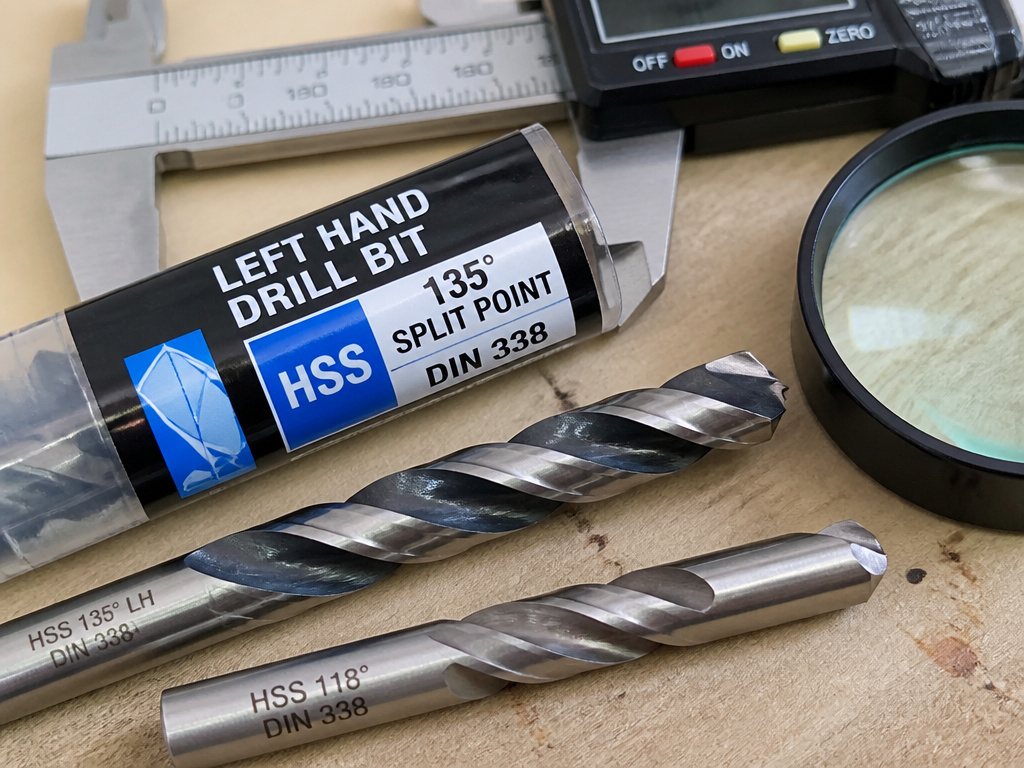 A left-hand bit looks familiar, but its specs tell a specific story. Knowing these terms lets you pick the right tool off the shelf.
- Material: High-Speed Steel (HSS) is the standard. It’s tough enough for most hardened bolts. For tougher alloys, look for HSS with cobalt or premium coatings.
- Point Angle: Two options dominate.
- 118° Point: A general-purpose angle. It cuts aggressively but can “walk” more on a curved surface. The Chicago-Latrobe 118° Left-Hand Jobber Bit is a classic example.
- 135° Split Point: The modern favorite for extraction. The self-centering split point eliminates walking, so you stay on target. The Lawson Left Hand Jobber Bit uses this 135° modified split point.
- Flute Length: Determines how deep you can drill. A “jobber length” bit is the standard for most workshop tasks.
- Standards: Quality bits meet formal specifications.
- DIN 338: A common European standard that defines dimensions and tolerances for left-hand spiral drills. The OREN HSS-G bit is made to this standard.
- ANSI/ASME B94.11M: The American standard governing drill geometry and tolerances. Brands like Cleveland and Greenfield (maker of Chicago-Latrobe) manufacture to ANSI tolerances.
Picking the Right Bit: A Model Comparison
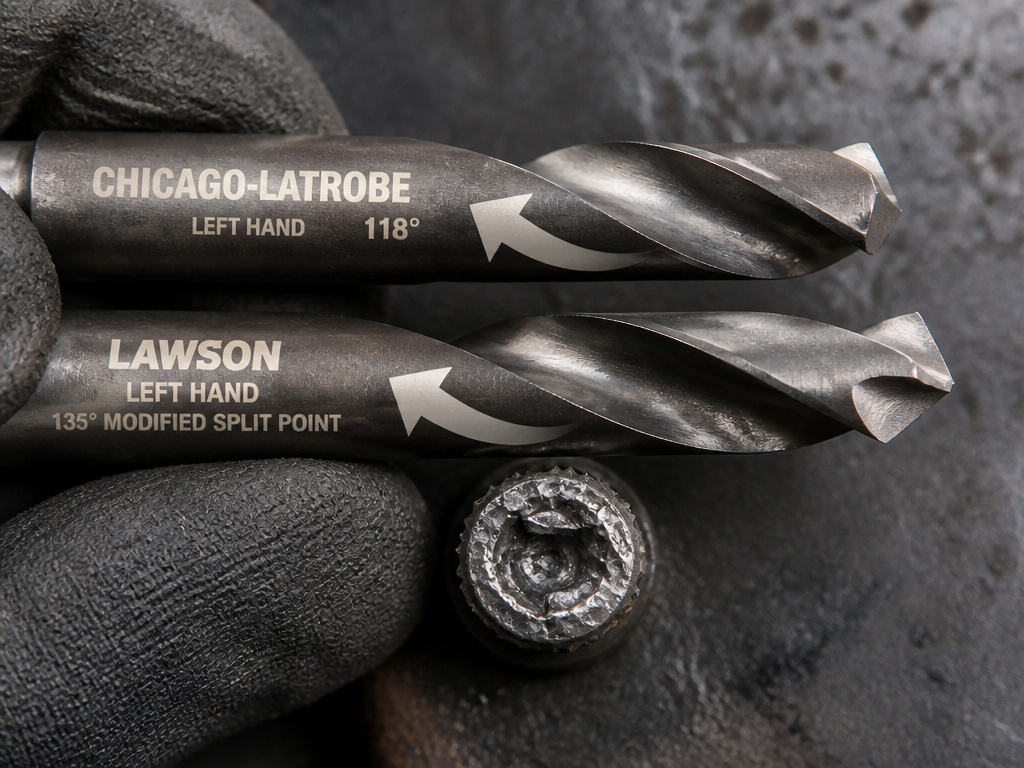 You don’t need a full set. You need the right size for the broken fastener you’re facing. Most DIYers are served by a small set of common sizes. Here are two proven designs.
For precision starting on small, broken screws, the Lawson Left Hand Jobber Drill Bit with its 135° modified split point is the winner. The self-centering tip is critical when you’re working on a 3/16″ bolt head already mangled by vise grips.
For general-purpose extraction in tougher steel, the Chicago-Latrobe 118° Left-Hand Jobber Bit offers a robust, aggressive cut. Its conventional point is less finicky about sharpening if you ever need to restore it.
The Cleveland left-hand drill bit series follows the same ANSI jobber-length standards, offering reliable performance if that’s what’s available. The choice often comes down to which point geometry you trust more for your specific problem.
When Not to Use a Left-Hand Drill Bit
This tool has a narrow lane. Using it outside that lane wastes time and breaks tools.
Skip the left-hand bit if:
- You are drilling a standard hole in wood, metal, or plastic. Use a standard bit.
- The broken fastener is extremely soft (like aluminum) and the extractor threads are more likely to grip without a pilot.
- You do not have a reversible drill or your drill’s reverse setting is weak. You need consistent counterclockwise torque.
- The fastener is welded or chemically bonded (e.g., with Loctite). The left-hand action won’t break the bond; you need heat or a chemical solvent first.
Common mistake: Forcing a left-hand bit as a last resort on a drill set to forward. You’ll smoke the bit, heat-harden the bolt, and turn a difficult job into an impossible one.
Safety & Operation Warnings
Before you start: Left-hand drill bits are brittle. Under side load or if they jam, they can shatter. Government regulations—and common sense—require safety glasses or a full face shield. Wear them. Every time.
- Secure the Workpiece. Use a vise or clamps. Trying to hold something while applying reverse torque is asking for injury.
- Start at a Low Speed. High RPMs generate heat quickly, which can anneal (soften) the bit’s cutting edge and destroy its temper.
- Use Cutting Fluid. When drilling metal, especially hardened steel, a drop of cutting oil or fluid reduces heat, extends bit life, and produces smaller, easier-to-evacuate chips.
- Clear Chips Frequently. Pull the bit out of the hole every few seconds to clear metal shavings. A clogged flute creates friction, heat, and increases the risk of the bit snapping.
Frequently Asked Questions
Can I use a left-hand drill bit in a regular drill?
Yes, but only if your drill has a reverse (counterclockwise) setting. That’s a non-negotiable requirement. Using it in the standard forward direction will not cut effectively and will likely tighten the broken fastener.
What’s the difference between a left-hand bit and a screw extractor?
Left-hand drill bit cuts material. Its goal is to drill a hole and, in doing so, hopefully back out the bolt. A screw extractor is a gripping tool. It has reverse-direction flutes that bite into the walls of a pre-drilled hole and turn the fastener out. They are often used together: the left-hand bit drills the pilot hole, then the extractor is tapped in.
Do left-hand drill bits work on stripped screws?
They can, but it’s a specific technique. You use the left-hand bit to drill out the head of the screw, destroying it and allowing you to remove the material above it. Once the head is gone, you can often grab the remaining shank with pliers. For screws stripped in the drive, a left-hand bit can sometimes catch the remaining metal if you drill off-center.
Are left-hand bits harder to sharpen?
They require the same basic technique as a standard bit—maintaining the correct point angle and equal lip height—but the flute orientation is reversed. If you use a standard drill sharpening jig, you must remember to orient the bit opposite to the instructions for a right-hand bit. Many pros simply replace worn left-hand bits, as they are specialty tools used infrequently.
What size left-hand bit should I buy?
Buy a small set that includes common sizes like 1/8″, 3/16″, 1/4″, and 5/16″. This covers most broken bolts from #8 machine screws up to 1/2″ bolts. For one-off jobs, buy the single bit size that matches the root diameter of the bolt you need to remove.
The Bottom Line
A left-hand drill bit isn’t a daily driver. It’s the specialized wrench you pull out when a bolt snaps flush or a screw head strips clean. Its value is in its counterclockwise twist, which turns a drilling operation into a fighting chance at extraction.
Keep a Lawson 135° split-point bit in your kit for small, precise work and a Chicago-Latrobe 118° bit for heavier stock. Remember the safety glasses, the center punch, and the low speed. When a standard bit would just make the problem worse, the left-hand bit is the tool that tries to solve it on the way in.
