
Learn How to Drill a Hole Without a Drill Using Simple Tools
This post contains affiliate links. As an Amazon Associate, we earn from qualifying purchases.
To drill a hole without a drill, you need a sharp, rigid tool and a method to apply rotational or percussive force. The right choice depends entirely on the material. For wood, use an awl, a nail and hammer, or a hand-powered rotary tool. For plastic, a heated nail or a hole saw works. For metal, a center punch and hammer or a manual hand drill is necessary. For masonry, a hammer and cold chisel is the only manual option. Each method has a strict size and precision ceiling.
The physical limitation is torque. Your arm cannot spin a tool fast enough to generate the cutting friction a power drill’s motor does. So manual methods either use leverage, like a brace and bit, or convert linear force into a cutting action, like a punch.
What follows is a breakdown of the tools that work, the materials they cut, and the exact steps that prevent broken tools and ruined projects. We’ll also cover the one scenario where official safety guidance is non-negotiable.
Key Takeaways
- An awl or a nail and hammer creates effective pilot holes in wood under 1/4 inch. Going larger requires a brace and bit or a hole saw.
- Plastic melts before it cuts. Use a heated nail or a rotary tool at low speed to avoid cracking and jagged edges.
- Drilling metal without power demands a center punch to start and a manual hand drill with a high-speed steel (HSS) bit. Expect blisters before you break through.
- The UK Health and Safety Executive (HSE) Publication A9 mandates specific containment procedures for drilling into asbestos cement or other bonded hazardous materials. This isn’t a suggestion.
- Every manual method has a practical size limit. Attempting a 1-inch hole in oak with a hand saw is a fast track to a ruined workpiece and a strained wrist.
The Core Tools for Manual Hole-Making
Your toolbox likely holds several hole-making tools that don’t need a cord. The job is matching the tool’s action to the material’s hardness.
An awl is a pointed spike used for piercing. It’s for marking and starting holes, not drilling them. You press and twist. A manual hand drill, or eggbeater drill, is a geared tool you crank. It provides real rotational force for bits up to 1/4 inch. A brace uses a sweeping motion for massive leverage, perfect for large-diameter bits in wood.
A manual hand drill converts slow arm cranks into high-speed bit rotation through a planetary gearset. The chuck typically accepts bits up to 10mm (3/8 inch), but attempting to drill hardened steel with a 10mm bit will stall the gears or snap the bit.
The part nobody mentions: Sharpness is everything. A dull awl skates. A dull nail mushrooms. A dull hole saw binds and snaps. Manual tools don’t have the RPM to power through a dull edge; they just generate heat and frustration.
Awl, Nail, and Punch
These are your entry-level perforators. They make holes by displacement, not by cutting.
Start with an awl for pilot holes in softwood or for marking drill centers in any material. Press the tip firmly where you want the hole and twist it back and forth. The tapered point widens the hole as you push deeper. For a quicker, slightly rougher hole in wood, drive a finish nail partway in with a hammer, then pull it out with the claw.
A center punch is for metal. You place the conical tip on a marked spot and strike it once with a ball-peen hammer. This creates a small dent that keeps a drill bit from wandering. It’s a starting aid, not a hole-making tool.
- Awl: Best for marking and pilot holes < 1/8″. Use a Stanley 0-84-100 or equivalent.
- Nail & Hammer: Fast for temporary holes or starting points in wood. The hole walls are compressed, not cut.
- Center Punch: Essential for metalwork. The dimple it creates is the only thing stopping your next tool from skating across the surface.
Skip the awl for hardwoods like maple or oak. The point will skate and mar the surface unless you first use a center punch to create a starting divot.
Manual Hand Drills and Braces
These are the true “drills without a drill.” They provide controlled rotation.
A manual hand drill is underestimated. The geared mechanism provides enough torque for 1/8-inch holes in mild steel and 1/4-inch holes in pine. The key is steady, even cranking and firm downward pressure. Let the tool do the work; forcing it strips the gears. For larger holes in wood, a carpenter’s brace is the traditional tool. The U-shaped handle gives incredible leverage for bits up to 1.5 inches.
Where this goes sideways: Cranking a hand drill too fast on metal. The bit heats up, loses its temper, and goes dull in seconds. You’ll see blueing on the bit’s flutes, and it will stop cutting entirely. Go slow, use cutting oil, and let the bit clear chips.
| Tool | Best For | Realistic Max Hole Size | Risk If Misused |
|---|---|---|---|
| Manual Hand Drill | Small holes in wood, thin metal | 3/8″ (10mm) in softwood | Stripped gears, snapped bits |
| Carpenter’s Brace | Large, deep holes in wood | 1.5″ (38mm) | Bit walking, torn-out wood on exit side |
| Archimedes Drill | Fine, precise holes (jewelry, models) | 1/16″ (1.5mm) | String breakage, inconsistent rotation |
The brace is a commitment. You need space to swing the handle, and the initial purchase of the bit’s center point is critical. If it walks, your hole ends up an inch away from your mark.
Material-Specific Methods and Limits
Wood, plastic, metal, and masonry each demand a different approach. The wrong tool doesn’t just fail, it destroys the workpiece.
Plastic is brittle. A standard drill bit can catch and crack acrylic or PVC. A heated nail is the simplest manual method. Hold the shank of a large nail with pliers, heat the tip over a gas stove or with a torch until it glows dull red, then press it through the plastic. It melts a clean hole. Let the plastic cool before moving it, or the melted edges will deform.
For metal, you need a cutting action. A hand drill with a sharp HSS bit works for sheet metal and thin bar stock. For anything thicker than 1/8 inch, you’re in for a long, arduous process. The manual method for a hole in a concrete wall is a hammer and cold chisel. You score a circle, then chip away the material inside it. It’s messy, inaccurate, and exhausting, it explains why rotary hammer drills were invented.
| Material | Recommended Manual Method | Alternative Method | Absolute Deal-Breaker |
|---|---|---|---|
| Wood | Brace & Bit | Hole saw + wrench | Using a screwdriver as a drill—it strips the head and mars the wood. |
| Plastic | Heated nail / soldering iron | Rotary tool with cutting wheel | A standard drill bit without a pilot hole—it will grab and crack the sheet. |
| Thin Metal | Hand drill + HSS bit + cutting oil | Center punch + hammer, then file | A dull bit—it work-hardens the metal, making it nearly impossible to drill later. |
| Masonry | Hammer & cold chisel | None. | Attempting this on a load-bearing structural wall without knowing what’s inside. |
The .095 vs .105 trade-off that burns out electric motors doesn’t apply here. Your arm is the motor. It fatigues. The practical limit for a hand-drilled hole in mild steel is about 1/4 inch deep. After that, muscle fatigue leads to wobbling, which leads to a broken bit.
When Safety Protocols Are Not Optional
Some materials aren’t just hard to drill, they’re hazardous. Asbestos cement, common in older roofing and siding, requires a contained process.
The UK’s HSE asbestos cement drilling guidance (Publication A9) is the definitive source. It’s not a best-practice list; it’s a controlled procedure. The sheet mandates using a drill at its lowest speed, covering both sides of the material with 500-gauge polythene, and sealing the drilling point with a thick paste or a drill cowl to capture all debris. Respiratory protective equipment (RPE) and disposable overalls are required.
Before you start on any older building material: If you suspect asbestos, stop. Drilling releases fibers that lodge in the lungs. The HSE procedure exists because the alternative is a documented, long-term health risk. No DIY workaround is worth that.
This is the one scenario where “how to drill a hole without a drill” intersects with “how to avoid causing irreversible harm.” The manual method is the same, a hand drill or a powered drill on low speed, but the containment, cleanup, and personal protection are the entire point.
Step-by-Step: Drilling a Clean Pilot Hole in Wood
This is the most common need. You’re hanging a shelf, assembling a kit, or installing a hinge. The goal is a clean, straight starter hole for a screw.
- Mark the center point precisely. Use a pencil and a square. Then, make a small dent with an awl or a center punch. This dent prevents the next tool from wandering. Skip this, and your hole will start half an inch off-line.
- Select your awl or nail. For holes under 1/8 inch, use the awl. Press firmly and twist clockwise, applying steady downward pressure. For a slightly larger hole, tap a finish nail into the dent to your desired depth.
- Enlarge if needed. If the pilot hole needs to be wider, use a manual hand drill with the correct size bit. Insert the bit, set the tip in your starter hole, hold the drill vertical, and crank steadily.
- Clear the debris. Blow or brush out the wood shavings. A clogged hole creates friction and can split the wood when you drive the screw.
The awl works because its tapered shape gradually compresses and splits wood fibers along a precise path. A nail works because its sharp point acts as a wedge, forcing fibers apart. Neither method removes material cleanly like a drill bit, which is why the holes are weaker and best used only as pilots.
Why a hand drill beats a power drill for this tiny job: Control. It’s almost impossible to blow through the back of a thin board with a hand drill. You feel the moment the bit is about to exit and can stop immediately.
Why Your “Alternative” Method Failed
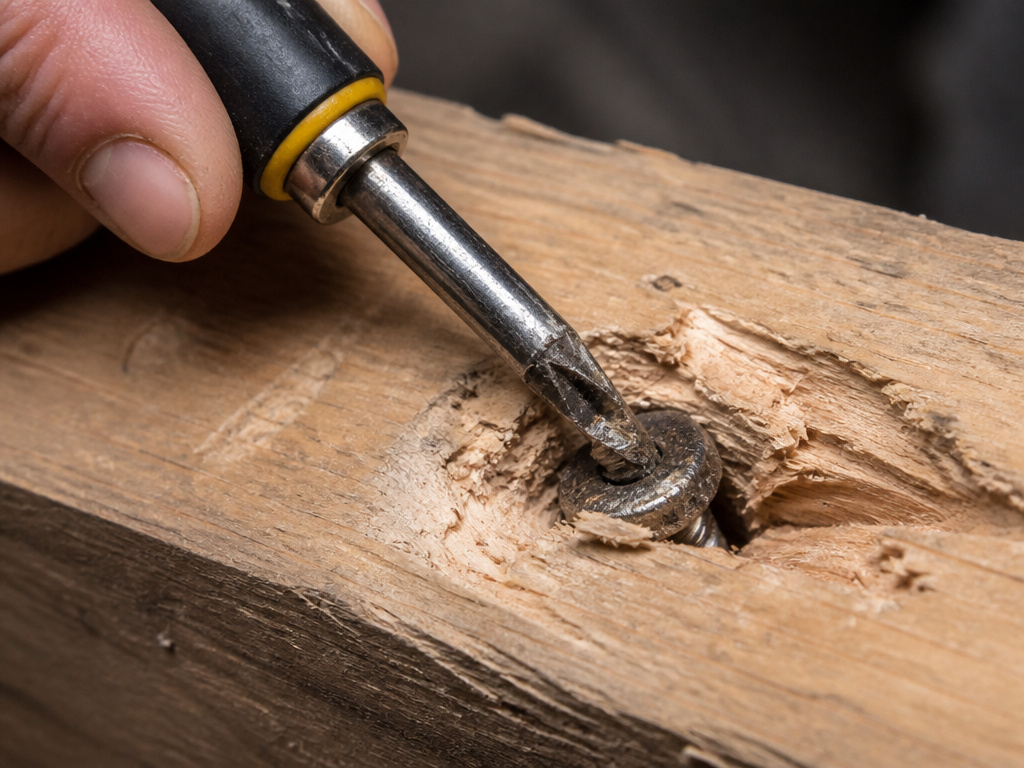 People get creative. They try using a screwdriver as a drill, a hammer and a Phillips head to make a hole, or a red-hot coat hanger. These usually end in damage.
A screwdriver tip is designed to cam out under torque. Using it as a drill rounds out the screw head and leaves a mangled, irregular hole. A hammer and a large nail might punch through thin sheet metal, but the exit side will have a jagged, burred crater that requires extensive filing. The red-hot coat hanger melts through plastic, but it cools too quickly, often fusing the plastic to the metal and leaving a ragged, tapered hole.
The common failure point is assuming hardness equals effectiveness. A hardened steel punch is hard, but it’s designed for impact, not rotation. Using it like a drill will snap the tip. Tools are designed for specific force vectors. Ignoring that breaks them.
Bottom line: If a method feels like a hack, it probably is. It might work once on a scrap piece, but it won’t be reliable, safe, or precise. The methods for making holes without a drill that last are the ones that use tools designed for controlled cutting or piercing.
Frequently Asked Questions
Can you use a screwdriver to drill a hole?
No. A screwdriver tip lacks cutting edges. It will rotate uselessly in a starter dent or, if forced, will tear the material and likely strip the screwdriver’s head. For a true hole, you need a tool that removes material, like a drill bit, an awl, or a punch.
What is the easiest way to make a small hole in plastic?
The easiest and cleanest way is with a heated nail. Hold a large nail with pliers, heat the tip until it’s hot enough to melt the plastic (test on a scrap), and gently push it through. The plastic melts away, leaving a smooth-edged hole. Let it cool before removing the nail.
How do you make a hole in metal without electricity?
You need a center punch, a hammer, and a manual hand drill with a high-speed steel (HSS) bit. First, use the punch and hammer to make a deep dimple where you want the hole. This prevents the drill bit from skating. Then, secure the metal, add a drop of cutting oil to the spot, and use the hand drill with steady, firm pressure. Expect it to take time and effort.
Is it possible to drill into concrete by hand?
It is possible, but not practical. The method is to use a hammer and a masonry cold chisel to score and chip out a hole. This is extremely labor-intensive, inaccurate, and will likely damage the surrounding concrete. For any hole deeper than 1/2 inch, a rotary hammer drill or even a standard hammer drill is the only realistic tool.
What safety gear do I need for manual drilling?
At minimum, safety glasses. Flying metal chips from a center punch or broken bit fragments are a real hazard. When working with metal, wear gloves to protect against sharp edges and burrs. If you are following a procedure like the official drilling safety PDF for hazardous materials, you must use the specified respiratory protection and disposable coveralls.
Before You Go
Drilling without a drill is about matching a tool’s fundamental action to your material’s properties. An awl pierces. A hand drill rotates. A punch displaces. Success comes from choosing the right one and respecting its limits.
For most small jobs in wood, a sharp awl and a little patience are all you need. For plastic, reach for the pliers and the stove. For metal, accept that it will be slow, and use cutting oil. And for anything that might contain asbestos, the only correct first step is to consult the HSE A9 guidance and decide if you’re equipped to follow it to the letter.
The right manual tool doesn’t just make a hole. It gives you control that a whirring power drill sometimes can’t. You feel the material give way. That feedback is the difference between a clean hole and a costly mistake.
